
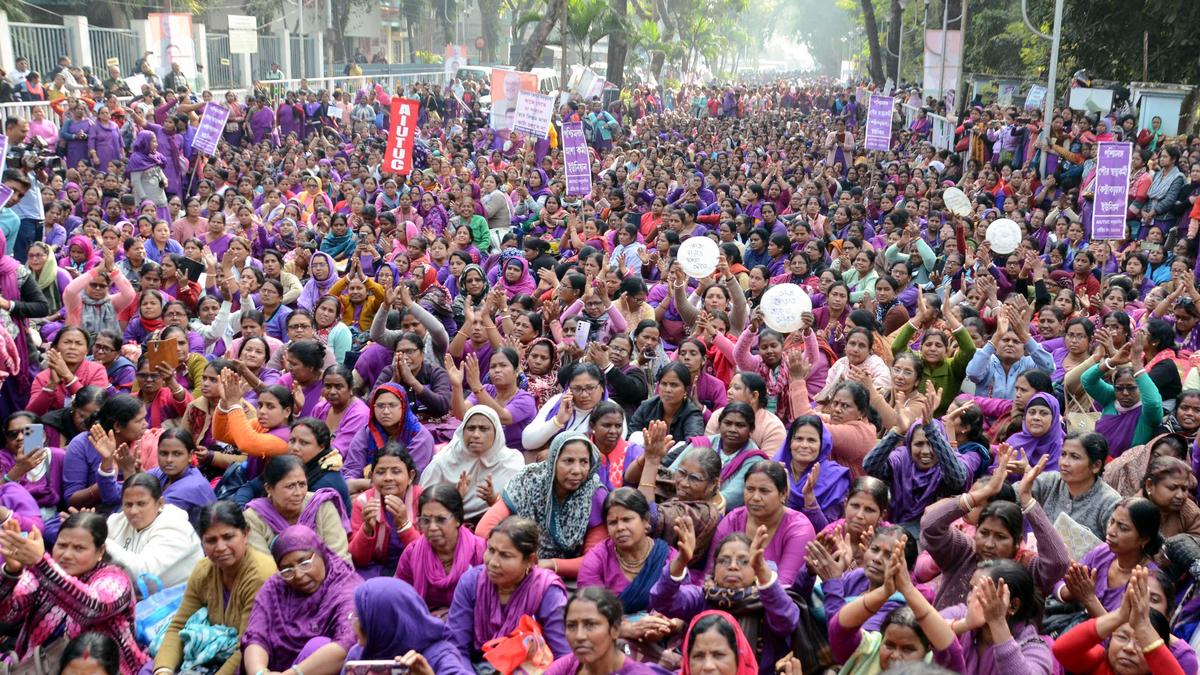
Wed Jan 07 22:45:00 UTC 2026: # ASHA Workers Protest for Fair Wages and Benefits in West Bengal
The Story:
Hundreds of Accredited Social Health Activists (ASHA) in West Bengal staged a protest at the Swasthya Bhawan in Kolkata on January 7, 2026, demanding better pay and insurance benefits. The protest, following a 15-day casework boycott, saw ASHA workers blocking roads and attempting to enter the Health Department headquarters. Their primary demands include raising their monthly honorarium to ₹15,000, compensation for death on duty of ₹5 lakhs, and recognition as permanent government employees.
Key Points:
- The protest took place at the Swasthya Bhawan in Kolkata on January 7, 2026.
- ASHA workers are demanding an increase in their monthly honorarium from ₹5,250 to ₹15,000.
- They are also seeking compensation of ₹5 lakhs in case of death on duty.
- Protesters want recognition as permanent government employees, not volunteers.
- There are approximately 70,468 ASHA workers in West Bengal as of September 2024, according to the Ministry of Women and Child Development.
- The ASHA workers have been boycotting work for over two weeks.
Critical Analysis:
The timing of the protest coincides with several other protest-related events across India and globally, as indicated by the provided historical context. These events range from political demonstrations (CPI-M protest against capture of Venezuelan President, JNUTA slamming administration for police complaint over slogans), to local political announcements (Spencer Pratt running for mayor, PM Modi to address rally in Bengal). This broader context suggests a climate of increased social and political activism, possibly influenced by a range of factors from economic grievances to global political issues. The ASHA workers’ protest may be part of this larger trend of marginalized groups asserting their demands.
Key Takeaways:
- ASHA workers in West Bengal are facing significant financial and job security challenges.
- The protest highlights the precarious working conditions of frontline healthcare workers in India.
- The government’s response to these demands will be crucial in determining future healthcare service delivery in the region.
- Increased social and political activism is happening globally and in India.
- Workers are feeling empowered to make demands of their employers.
Impact Analysis:
The ASHA workers’ protest has the potential to significantly impact the healthcare system in West Bengal. If their demands are met, it could improve worker morale and retention, leading to better healthcare outcomes for vulnerable populations. Conversely, failure to address their concerns could lead to prolonged disruptions in healthcare services and further erode trust in the government. The outcome of this situation may also serve as a precedent for ASHA workers in other states and influence national healthcare policies.
 First Piper