
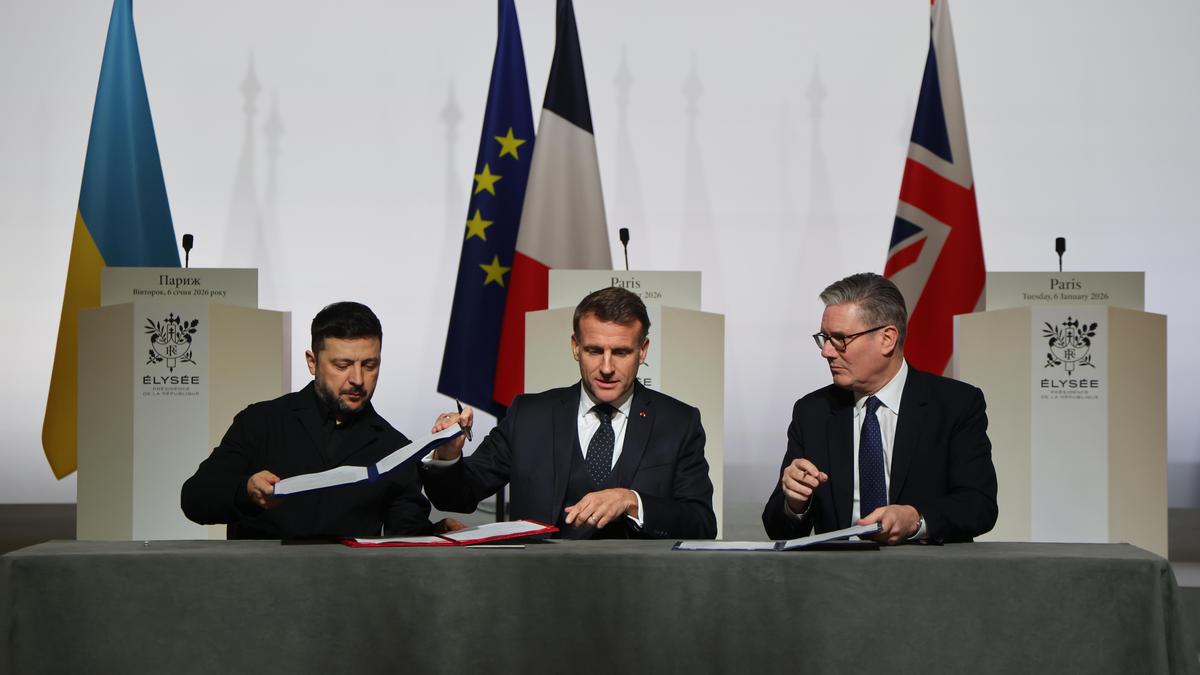
Tue Jan 06 22:02:00 UTC 2026: ### Ukraine’s Allies Forge Security Guarantees Amid Shifting Geopolitical Landscape
The Story:
In Paris on January 6, 2026, Ukrainian President Volodymyr Zelenskyy, French President Emmanuel Macron, and British Prime Minister Keir Starmer signed a declaration solidifying security guarantees for Ukraine at the ‘Coalition of the Willing’ summit. The agreement, endorsed by Ukraine’s allies including the U.S., aims to establish ceasefire monitoring mechanisms and long-term military assistance to Ukraine, post a potential peace settlement with Russia. However, the summit occurred amidst escalating geopolitical tensions, including the U.S. military intervention in Venezuela and renewed interest in acquiring Greenland, creating a complex diplomatic environment.
Key Points:
- A security statement was endorsed by Ukraine’s allies, including the U.S., as a “significant step” towards ending Russia’s invasion.
- Agreement on ceasefire monitoring mechanisms was reached under U.S. leadership.
- Long-term military assistance and armament to Ukraine’s armed forces were agreed upon, to be the first line of defence after any peace deal.
- Foreign countries will provide reassurance measures on land, sea, and in the air after a credible cessation of hostilities.
- The Trump administration’s focus is shifting to Venezuela, while U.S. suggestions of a Greenland takeover are causing tension with Europe.
- U.S. envoys Steve Witkoff and Jared Kushner met with Macron for preparatory talks.
- Ukraine’s Security Service (SBU) conducted drone strikes on a military arsenal and an oil depot deep inside Russia.
Critical Analysis:
The timing of the “Coalition of the Willing” summit is crucial. The U.S. intervention in Venezuela, indicated by Secretary of State Marco Rubio changing his plans and reported in the primary article, significantly diverts American attention and resources away from the European theater. This shift creates uncertainty regarding the U.S.’s commitment to the security guarantees for Ukraine, especially given that President Trump is concurrently pushing for a Greenland takeover, causing friction with European allies. Simultaneously, news emerging of a “New Venezuelan leader,” indicates a possible success in a US-backed regime change and may signal a shifting of US geopolitical priorities. Russia, seeing a potentially weakened and distracted Western alliance, may be less inclined to compromise in peace negotiations.
Key Takeaways:
- The security guarantees for Ukraine are contingent on sustained international support, which is now complicated by competing geopolitical priorities.
- The U.S.’s actions in Venezuela and pursuit of Greenland have strained relations with European allies, potentially undermining the “Coalition of the Willing.”
- Russia’s intransigence in negotiations may stem from a perceived weakening of Western resolve due to the shifting global landscape.
- Ukraine is actively escalating the conflict by conducting strikes deep within Russian territory, potentially undermining peace efforts.
- The success of the security guarantees hinges on the finalization of “binding commitments” and the willingness of key nations, particularly the U.S., to uphold them.
Impact Analysis:
The long-term impact of this event series is potentially destabilizing for European security. If the U.S. remains preoccupied with Venezuela and Greenland, the credibility of the security guarantees to Ukraine will erode. This could embolden Russia to pursue further territorial ambitions, not only in Ukraine but potentially in other Eastern European nations. A weakened transatlantic alliance would necessitate Europe to take on a more significant security burden, requiring increased defense spending and potentially altering the power dynamics within NATO. The drone strikes by Ukraine inside Russia can cause an escalation of the conflict, possibly leading to a wider war with the involvement of other nations. The success or failure of this “Coalition of the Willing” will shape the future of European security architecture for decades to come.
 First Piper