
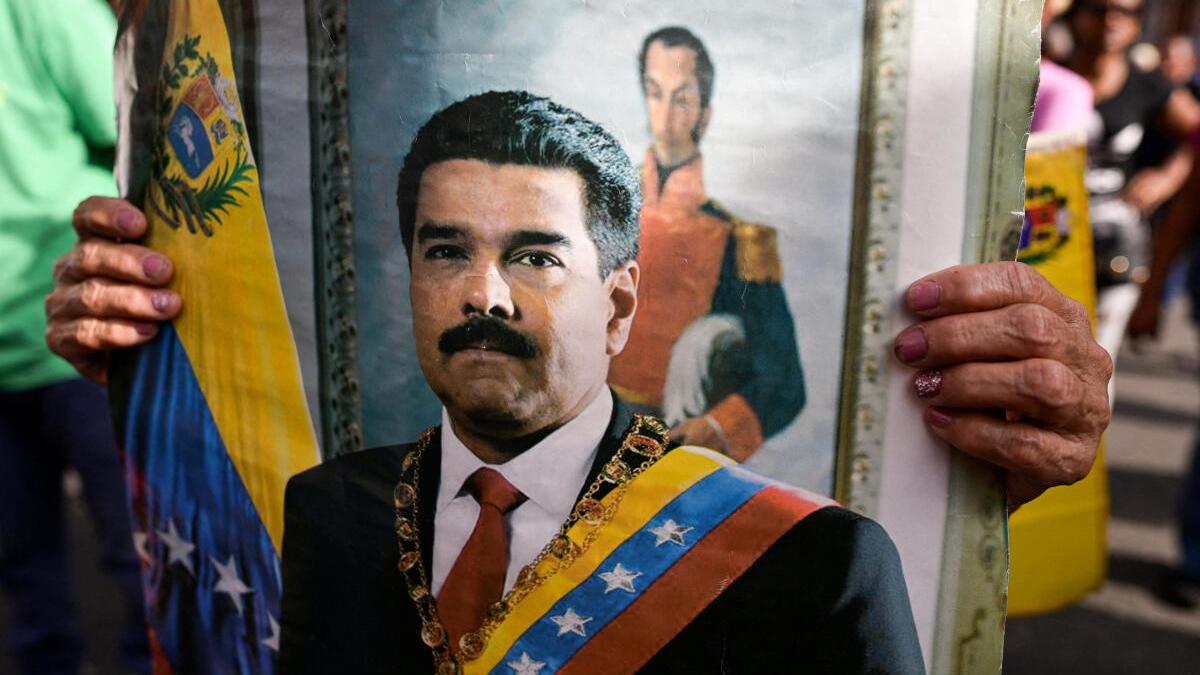
Mon Jan 05 07:27:45 UTC 2026: # Trump’s U.S. Invades Venezuela, Abducts President Maduro, Sparking Global Outcry
The Story:
On January 6, 2026, the United States, under President Donald Trump, executed a military invasion of Venezuela, culminating in the capture of President Nicolas Maduro and his wife. They were subsequently flown to New York to face drug-trafficking charges. The intervention, dubbed a “special operation” by the U.S., has resulted in at least 40 deaths in Venezuela and has been widely condemned as a violation of international law. The event is viewed by many as a continuation of U.S. imperialism, driven by desires to reimpose American primacy in the Western Hemisphere, counter Chinese and Russian influence, and control Venezuela’s oil reserves.
Key Points:
- The U.S. invaded Venezuela and captured President Nicolas Maduro on January 6, 2026.
- Donald Trump cited drug-trafficking charges as the justification for abducting Nicolas Maduro.
- At least 40 people are reported dead in Venezuela as a result of the U.S. military intervention.
- The invasion is being criticized as a violation of international law and an act of U.S. imperialism.
- Donald Trump’s motives are believed to include reimposing American primacy in the Western Hemisphere, countering Chinese and Russian influence, and securing access to Venezuela’s oil reserves.
- Many governments are reacting with silence or fence-sitting comments, drawing criticism for hypocrisy compared to their responses to Russian aggression in Ukraine and the potential Chinese intervention in Taiwan.
Critical Analysis:
The timeline of related historical context reveals a planned sequence of events leading up to the invasion. The CIA’s assessment that regime loyalists are best suited to lead Venezuela after Maduro, suggests the U.S. had specific individuals in mind to replace Maduro, indicating a level of pre-planning and desired control over the outcome. The shift in U.S. focus from Ukraine to Venezuela is a significant detail, particularly given that negotiations were underway in Paris, which were left uncertain.
Key Takeaways:
- The U.S. invasion of Venezuela under Donald Trump represents a significant escalation of American interventionism in Latin America.
- The event highlights the selective application of international law and the “rules-based world order” by powerful nations like the United States, particularly in comparison to criticisms directed at Russia and China.
- The muted global response to the U.S. action, compared to reactions towards other geopolitical events, exposes a potential double standard in international relations.
- The CIA’s pre-invasion assessment indicates a calculated plan for regime change beyond just removing Nicolas Maduro, suggesting a broader strategy for controlling Venezuelan politics.
Impact Analysis:
The U.S. invasion of Venezuela has far-reaching implications:
- Regional Instability: The invasion is likely to further destabilize Venezuela and potentially other Latin American countries, exacerbating existing economic and political crises.
- Geopolitical Realignments: The event could push Venezuela closer to China and Russia, strengthening their influence in the region and challenging U.S. dominance.
- Erosion of International Norms: The blatant disregard for international law could embolden other nations to pursue unilateral actions, further undermining the international system.
- Humanitarian Crisis: The military intervention and resulting instability could lead to a humanitarian crisis, including displacement, food shortages, and increased violence.
 First Piper