
Mon Dec 29 18:52:20 UTC 2025: Okay, here’s a news article summarizing the provided text:
Tamil Nadu’s Health Insurance Scheme Transforms Access to High-End Medical Procedures
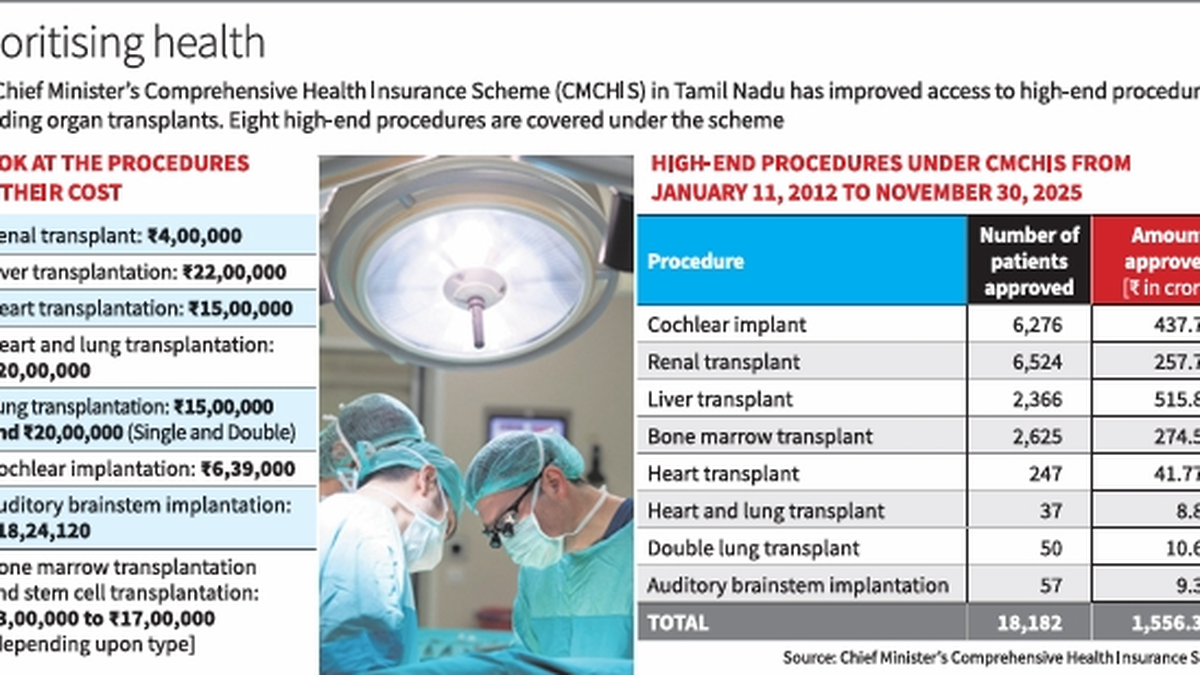
CHENNAI, December 30, 2025 – Tamil Nadu’s Chief Minister’s Comprehensive Health Insurance Scheme (CMCHIS) has significantly improved access to life-saving high-end medical procedures for its residents. Since January 2012, over 18,000 patients have benefited from the scheme, undergoing complex procedures such as organ transplants, cochlear implants, and bone marrow transplants. The state has invested over ₹1,500 crore (approximately $190 million USD) in these critical healthcare interventions.
According to official data released today, 18,182 individuals have received treatment under CMCHIS between January 11, 2012 and November 30, 2025, with a total expenditure of ₹1,556.35 crore. Renal transplants accounted for the largest number of beneficiaries (6,524), followed by cochlear implants (6,276). Liver transplants, while fewer in number, incurred the highest cost at ₹515.83 crore, with the scheme allotting ₹22,00,000 for the procedure. Costs exceeding the standard insured amount of ₹5,00,000 are covered by the CMCHIS Corpus Fund, which is supported by deductions from claim amounts paid to government hospitals.
Healthcare professionals are hailing the CMCHIS as a game-changer for marginalized communities. M. Edwin Fernando, Head of Nephrology at Government Stanley Medical College Hospital, highlighted that renal transplants, which can cost ₹8-10 lakh in private hospitals, are provided completely free of charge to CMCHIS cardholders with a suitable donor at his institution. “Finance is not a constraint for them to access procedures such as renal transplants,” he said.
Mohan Kameswaran, Managing Director of Madras ENT Research Foundation, emphasized the impact of the scheme on children with hearing impairments, noting that over 5,000 children from below the poverty line have received cochlear implants. “This is a phenomenal number for a government-sponsored programme,” Kameswaran stated. “The scheme has addressed social disparities. The investment is the most cost-effective as children, who form the future society, have benefitted.”
Kameswaran further called on the state to introduce a universal newborn hearing screening program and expand habilitation services, advocating for satellite centers in government medical college hospitals across districts to improve access to post-implantation care.
 First Piper