
Wed Dec 03 10:00:00 UTC 2025: Summary:
Researchers at the University of Science and Technology of China have successfully conducted an experiment that proves Niels Bohr’s rebuttal of Albert Einstein’s challenge to quantum theory. Einstein’s thought experiment involved observing the recoil of a slit as a photon passed through, attempting to simultaneously determine the photon’s path and observe interference. The Chinese researchers recreated this experiment using a trapped atom and found that as certainty about the photon’s path increased, the interference pattern diminished, thus validating Bohr’s principle of uncertainty inherent in quantum mechanics.
News Article:
Einstein’s Quantum Challenge Put to the Test: Chinese Scientists Validate Bohr’s Uncertainty Principle
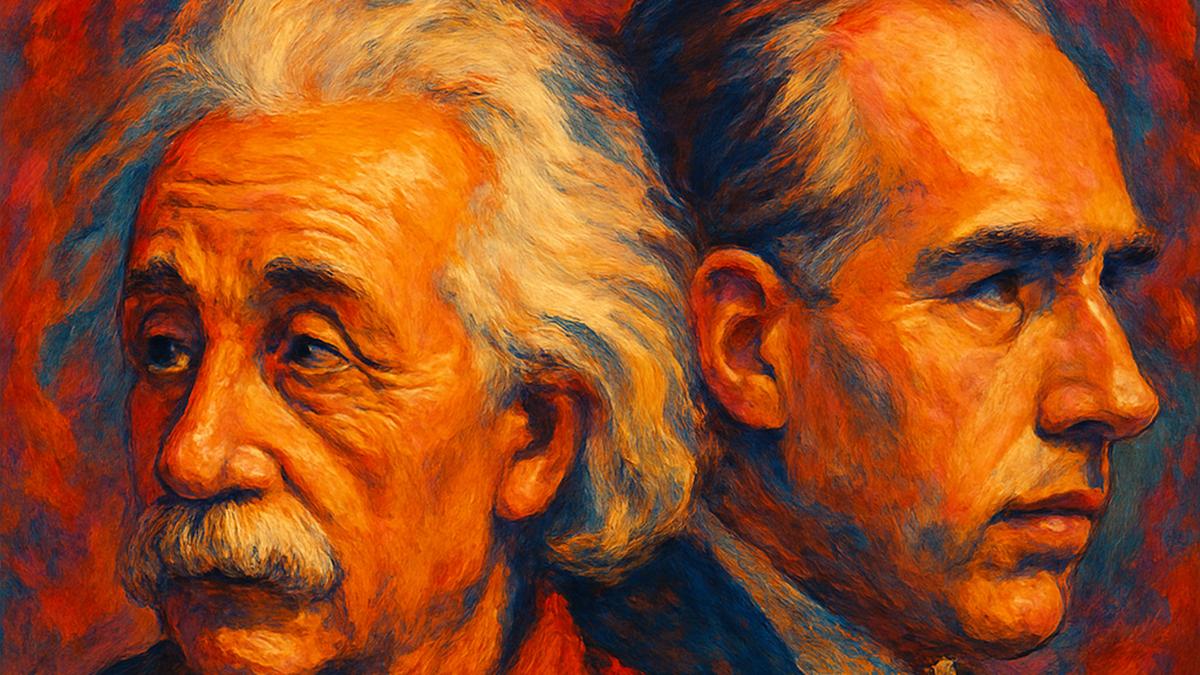
December 3, 2025 – A decades-long debate over the foundations of quantum mechanics appears to be settled, thanks to a groundbreaking experiment by researchers at the University of Science and Technology of China. The team successfully replicated a complex thought experiment proposed by Albert Einstein in the 1920s, designed to challenge Niels Bohr’s assertion that uncertainty is an integral part of nature.
Einstein’s idea revolved around a double-slit experiment where the slits were movable. The goal was to measure the recoil of the slit as a photon passed through, theoretically allowing scientists to determine the photon’s path while simultaneously observing the interference pattern characteristic of wave behavior. Einstein believed this could expose a flaw in quantum theory.
However, Bohr countered that the attempt would fail due to inherent quantum uncertainties. For nearly a century, the debate remained theoretical, as technology couldn’t test Einstein’s concept.
Now, Chinese researchers have achieved what was once considered impossible. Replacing the physical slit with a precisely controlled atom held in place by a laser, the team fired photons at the atom. By carefully measuring the atom’s recoil (the “kick” it received from the photon), they could gain information about the photon’s path.
The experiment revealed a crucial relationship: when the uncertainty in the atom’s momentum was high, making it impossible to precisely determine the photon’s path, a clear interference pattern emerged. Conversely, when the uncertainty was minimized, allowing for more accurate path determination, the interference pattern diminished.
These findings precisely match Bohr’s predictions and effectively validate his interpretation of quantum mechanics. The results, published in Physical Review Letters on December 2nd, demonstrate the fundamental principle of uncertainty at the heart of quantum theory.
“This experiment not only settles a historic debate but also provides a valuable platform for exploring the transition from quantum to classical behavior,” stated a representative from the University of Science and Technology of China. “The techniques developed may also have significant implications for future quantum technologies.”
The success of this experiment marks a significant milestone in the understanding of quantum physics and offers new avenues for exploring the mysteries of the universe.
 First Piper