
Sun Nov 16 09:09:05 UTC 2025: News Article:
Astronomers Detect Mega-Storm on Distant Star, Raising Questions About Exoplanet Habitability
Paris, November 16, 2025 – In a groundbreaking discovery published in Nature, an international team of astronomers has detected an extraordinarily powerful storm erupting from a red dwarf star located 133 light-years away. Using data from the LOFAR (Low-Frequency Array) European telescope network, the team observed a coronal mass ejection (CME) on the star StKM 1-1262, an event vastly more violent than anything ever recorded on our own sun.
“It’s the first time we have detected one [CME] on a star other than our own,” said Cyril Tasse, a Paris Observatory astronomer and co-author of the study. The detected CME was at least 10,000 times more powerful than solar storms observed on the sun.
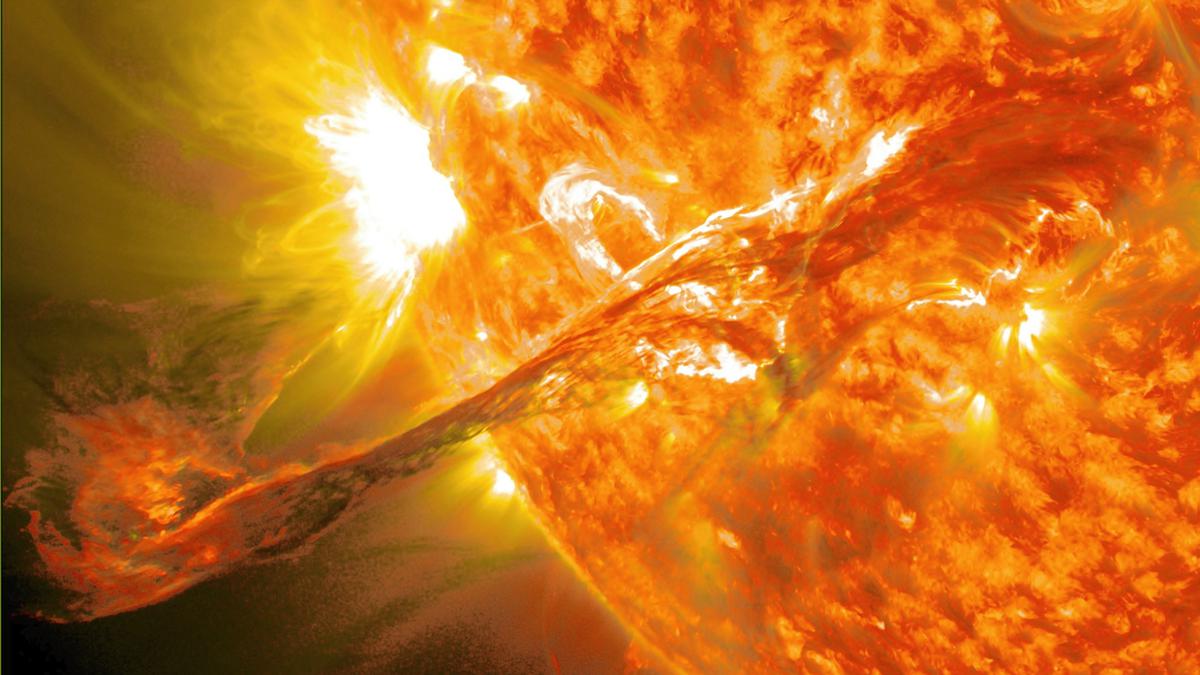
Coronal mass ejections are huge expulsions of plasma and magnetic field from the sun’s corona. On Earth, these storms can disrupt satellites and cause spectacular auroras. This makes this detection extremely important for studies of space weather in other systems.
The finding has significant implications for the search for habitable exoplanets. Red dwarf stars, smaller and cooler than our sun, are the most common type of star in the Milky Way and are often found to host Earth-sized planets. However, the erratic and violent nature of these stars, as evidenced by this discovery, suggests that planets orbiting them may be subjected to frequent and intense radiation bursts, potentially stripping away their atmospheres and rendering them uninhabitable.
“This emerging field opens up major perspectives for how the magnetic activity of stars influence the habitability of the planets that surround them,” explains Philippe Zarka, another research director at the Paris Observatory and study co-author.
The research suggests that the search for life beyond Earth may need to consider the impact of extreme stellar weather on the habitability of potentially life-bearing exoplanets.
 First Piper