
Wed Sep 24 00:00:00 UTC 2025: ## India Aims for Fusion Power by 2060 with Ambitious New Reactor
**NAGPUR, September 24, 2025** – Indian scientists at the Institute for Plasma Research (IPR) in Gandhinagar have unveiled a roadmap to develop India’s first fusion electricity generator by 2060. The project, dubbed “Steady-state Superconducting Tokamak-Bharat” (SST-Bharat), aims to generate 130 MW of power, with 100 MW derived from a fusion-fission hybrid reactor, exceeding its input power by five times. The estimated construction cost is Rs 25,000 crore.
“Fusion is the process where two small, light atoms come together to form a bigger, heavier atom. When this happens, a huge amount of energy is released,” explained Daniel Raju, Dean of academics and student affairs at IPR. Nuclear fusion, the process that powers stars, offers a potentially cleaner alternative to fission, producing less radioactive waste.
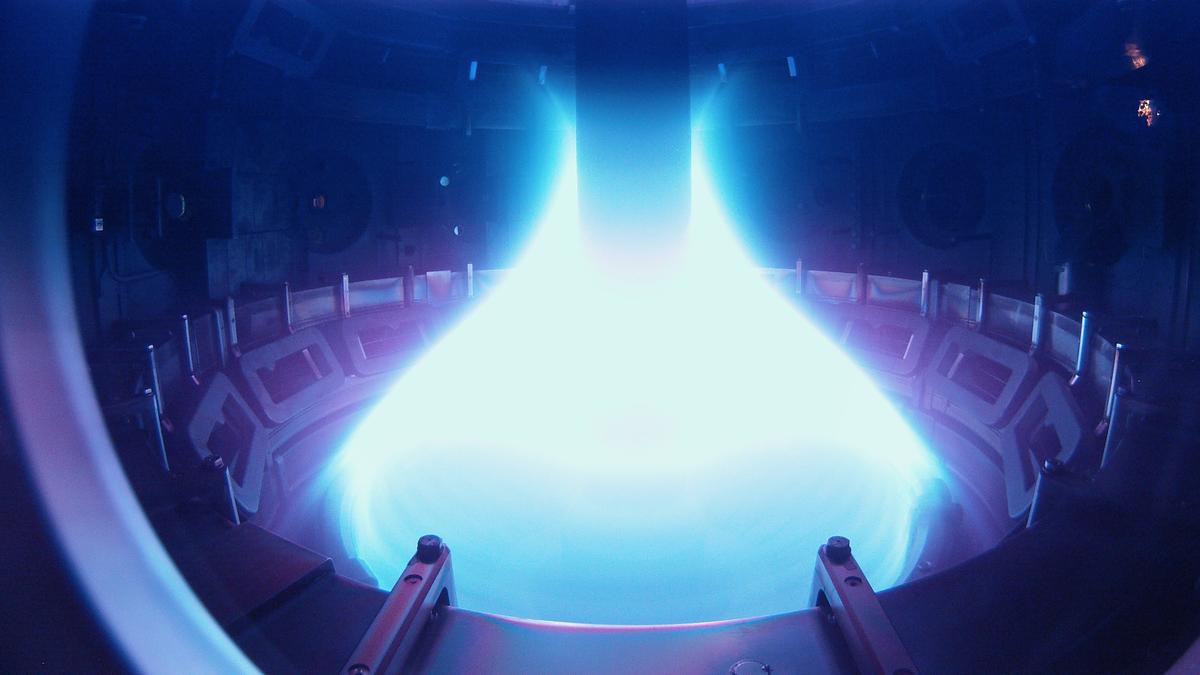
The SST-Bharat project will utilize magnetic confinement, a technique that involves heating plasma to extreme temperatures and containing it using powerful magnetic fields. India is already involved in magnetic confinement research through its participation in the International Thermonuclear Experimental Reactor (ITER) project in France.
While ITER aims for a Q value (output power to input power ratio) of 10, India’s ultimate goal is to achieve a Q value of 20 in a full-scale demonstration reactor, generating 250 MW of power by 2060. Achieving such a high Q value is crucial for the commercial viability of fusion power.
To accelerate progress, the IPR team has proposed developing digital twins, virtual replicas of tokamak reactors, to test new designs and troubleshoot issues. They also advocate for machine learning-assisted plasma confinement and the development of radiation-resistant materials.
Despite the ambitious goals, the timeline remains uncertain, and the economic viability of fusion power is still unproven. M.V. Ramana, Simons Chair in Disarmament, Global and Human Security at the University of British Columbia, cautioned that “timelines in nuclear fusion are never realistic.”
Funding also poses a challenge. While the EU and US are investing heavily in fusion R&D, India’s budgets remain modest and largely public-sector driven. The absence of significant private sector involvement in India also contrasts with the global surge in fusion start-ups.
Despite the challenges, the researchers argue that fusion R&D will yield valuable spin-offs in areas like radiation-hardened materials and superconducting magnets, potentially boosting Indian industry and strengthening technological autonomy.
“Since its [commercial viability hasn’t been demonstrated so far], we are aware that it would be difficult to push it as a potential source of energy in the near future,” Raju said. “Since a lot of private [entities], start-ups and government bodies across the world are jumping into fusion energy, it makes sense for us to go with optimism and align our domestic fusion energy programmes with the world.”
 First Piper