
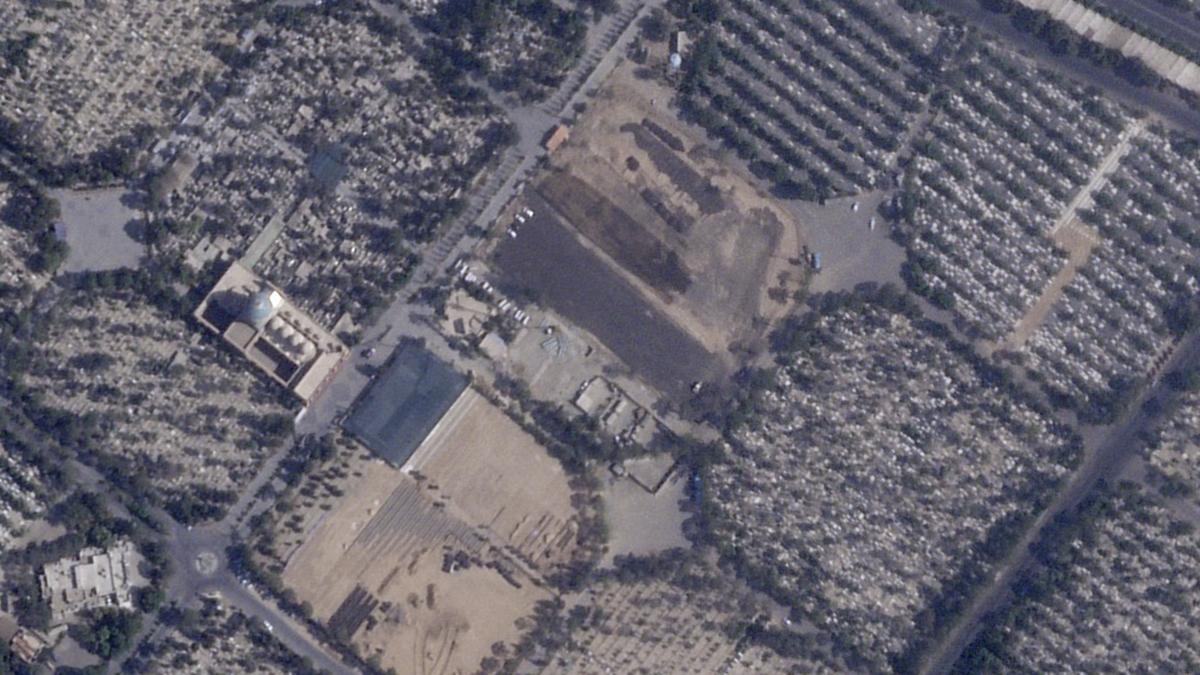
Sat Sep 06 06:57:25 UTC 2025: **Summary:**
The Iranian government is paving over Lot 41 in Behesht-e Zahra cemetery in Tehran, where victims of the 1979 Islamic Revolution’s mass executions are buried. This action, described as the final phase of destruction by researchers, follows years of desecration and is seen as an attempt to erase evidence of past atrocities. Iranian officials claim the area is being converted into a parking lot to serve visitors of a neighboring section for war casualties. Critics argue that this is a violation of regulations and an act of moral and legal wrongdoing. This event underscores concerns about impunity for human rights violations in Iran.
**News Article:**
**Iran Paves Over Graves of Revolution Victims, Sparking Outcry**
**Dubai – September 6, 2025** – The Iranian government is facing international condemnation after satellite imagery revealed the paving over of Lot 41, a section of Tehran’s Behesht-e Zahra cemetery where victims of the 1979 Islamic Revolution’s mass executions were buried. The action, confirmed by Iranian officials, is underway, with the site being transformed into a parking lot.
The destruction of the graves comes after years of alleged desecration, including vandalism and the drying out of trees in the area. Critics say the move is a deliberate attempt to erase evidence of the regime’s past human rights abuses and prevent accountability.
“The decision to convert this section into a parking lot fits into this broader pattern and represents the final phase of the destruction process,” said Shahin Nasiri, a lecturer at the University of Amsterdam who has researched Lot 41.
Iranian Deputy Mayor Davood Goudarzi stated that the area, where “hypocrites of the early days of the revolution were buried,” had been neglected for years. He added that authorities had approved the parking lot project due to the need for parking spaces for visitors to a neighboring lot where victims of the recent Iran-Israel war are planned to be buried.
However, Mohsen Borhani, a lawyer in Iran, criticized the action as neither moral nor legal, noting that ordinary people were also buried in Lot 41. According to researchers, the section contains 5,000 to 7,000 graves of individuals considered “religious outlaws” by the regime.
Rights groups, including the New York-based Centre for Human Rights in Iran, have denounced the destruction as a continuation of a pattern of impunity for atrocities. “Impunity for atrocities and crimes against humanity has been building for decades in the Islamic Republic,” said Hadi Ghaemi, the Centre’s executive director. “There is a direct line between the massacres of the 1980s, the gunning down of demonstrators in 2009, and the mass killings of protesters in 2019 and 2022.”
The incident is likely to further strain Iran’s relations with the international community and raise concerns about its commitment to human rights. The move appears to clash with Iran’s own regulations, which require consent of families for cemetery repurposing.
 First Piper