
Thu Jul 17 12:21:33 UTC 2025: Okay, here’s a news article summarizing the provided text:
**Headline: Indian Astronomers Discover Radio Emission Providing Clues to Formation of Massive Stars**
**Thiruvananthapuram, July 17, 2025** – An international team of astronomers, led by researchers from the Indian Institute of Space Science and Technology (IIST), has made a significant discovery regarding the formation of massive stars. They have detected radio emission with circular polarization near a young, massive protostar, approximately 4,500 light-years away in the Milky Way galaxy.
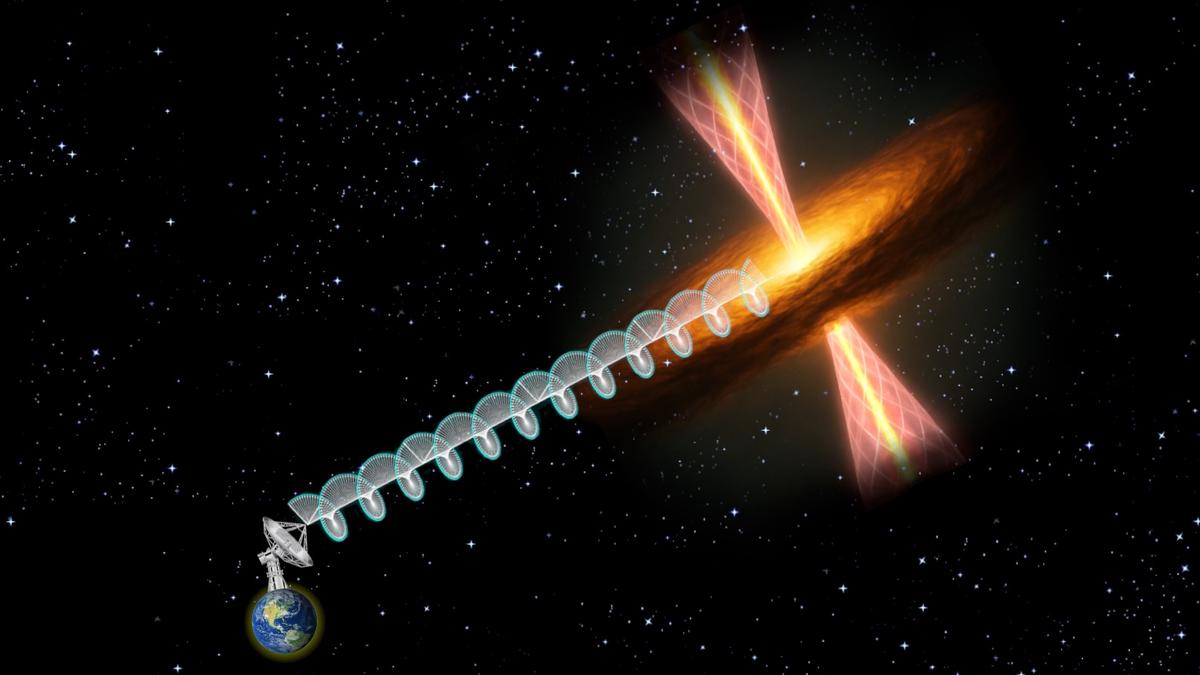
The protostar, identified as IRAS 18162-2048, is in the earliest stage of its development, still accumulating gas and dust. The circular polarization of the radio waves provides a direct measurement of the strength of magnetic fields in the protostar’s immediate environment, offering valuable insight into how stars eight to ten times the mass of our Sun are formed. The findings were published in The Astrophysical Journal Letters.
“This is the first inference of the magnetic field strength using circular polarisation in radio waves from a massive protostar,” said Sarita Vig of the IIST, who conceptualised the work.
This protostar powers one of the largest and brightest known protostellar jets in the Milky Way, called the HH80-81 jet. While magnetic fields have been observed in these jets, this is the first time they have been detected directly from the protostar itself.
Amal George Cheriyan, the lead author of the paper, explained the challenges involved in the research. “Massive protostars are much harder to study. The circular polarisation we are looking for is very faint and sporadic, making such measurements very challenging.”
Using data obtained from the National Radio Astronomy Observatory’s Karl G. Jansky Very Large Array (VLA) in the U.S., the researchers were able to determine that the magnetic field near the protostar is approximately 100 times stronger than Earth’s magnetic field. This discovery supports the theory that powerful jets emanating from stars and black holes are driven by similar magnetic processes.
“The detection of circular polarisation is an exceptionally rare and challenging feat even in active galactic nuclei (AGNs), where conditions are extreme, but better investigated,” said Nirupam Roy from the Indian Institute of Science (IISc), Bengaluru.
This breakthrough promises to advance our understanding of the complex processes governing the birth of massive stars and the role of magnetic fields in these stellar nurseries.
 First Piper