
Fri Jul 04 06:30:30 UTC 2025: Okay, here’s a news article based on the provided text:
**Headline: Vera C. Rubin Observatory Opens Window to Universe, Hunting Dark Matter and Killer Asteroids**
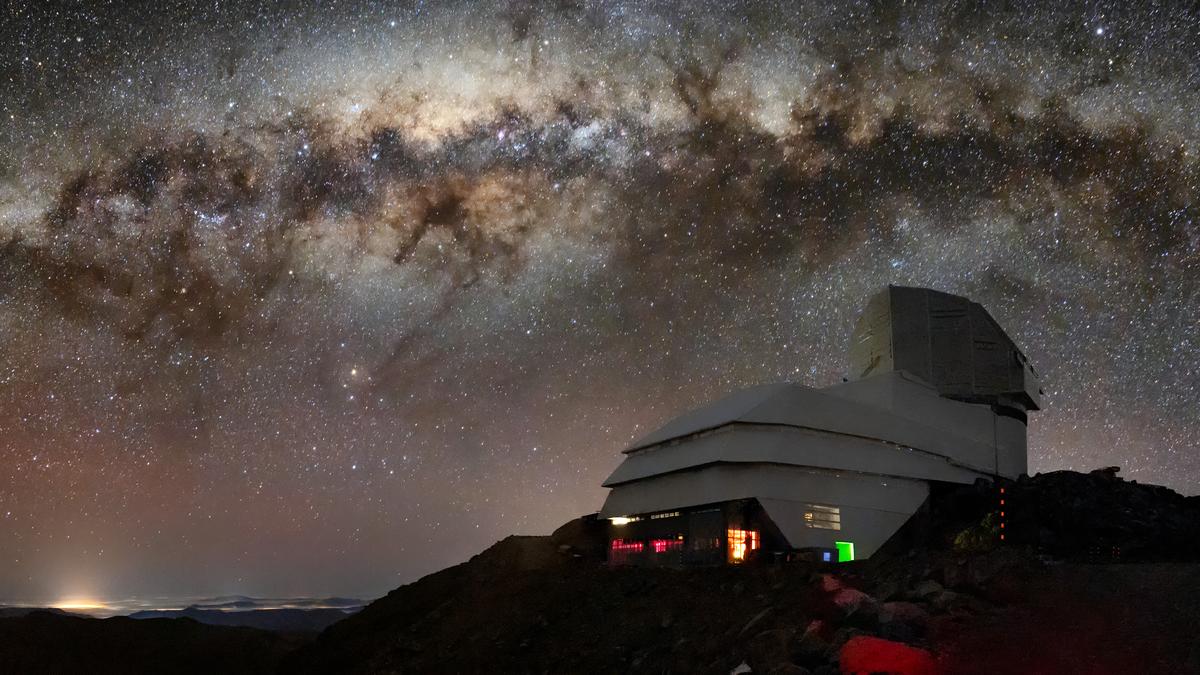
**Cerro Pachón, Chile – July 4, 2025:** The Vera C. Rubin Observatory (VRO), a groundbreaking astronomical facility, has officially opened its doors, promising an unprecedented view of the cosmos. Located atop Cerro Pachón in Chile and jointly funded by the U.S. National Science Foundation and the Department of Energy, the VRO boasts an 8.4-meter telescope equipped with a 3,200-megapixel camera, 67 times the megapixels of an iPhone 16 Pro.
The VRO’s unique design allows it to capture wide-angle images, equivalent to seven full moons, and to scan the entire southern hemisphere sky every three nights for a decade. This will create the longest astronomical time-lapse movie ever, revolutionizing our understanding of the solar system and deep space. Early images reveal stunning views of the Trifid and Lagoon nebulae, and the Virgo galaxy cluster.
One of the VRO’s primary goals is to unravel the mysteries of dark matter, the invisible substance that makes up 80% of the universe. By mapping the distribution of galaxies, astronomers hope to determine the properties and composition of this elusive material.
Beyond dark matter, the observatory will also play a crucial role in identifying potentially hazardous asteroids. While only 30% of asteroids smaller than 140 meters are currently known, the VRO is expected to increase this to 90%, allowing scientists to locate and potentially deflect “killer asteroids” that could threaten Earth. In its first week of observations, the observatory identified 2,104 new asteroids.
The VRO will also map the distribution of stars in the Milky Way, uncovering stellar streams that reveal the history of galactic mergers. Furthermore, it will discover millions of objects with variable brightness, including supernovae, eclipsing binary stars, and pulsating stars.
The observatory was renamed in 2019 to honor Vera C. Rubin, a pioneering astronomer whose work provided the first evidence for the existence of dark matter. The VRO’s “Legacy Survey of Space and Time” will continue Rubin’s work by observing billions of galaxies to help understand the nature of dark matter. While the James Webb Space Telescope is more sensitive, it observes a smaller patch of the sky. The VRO is looking at the bigger picture of the universe. The 473-million-dollar facility has a 60-second window to alert for any changes that are detected. The VRO will generate around 10 million alerts from 20 TB of raw data collected every night.
 First Piper