
Wed Jun 11 13:10:33 UTC 2025: **Summary:**
Archaeologists from the University of Kerala have unearthed a 5,300-year-old Early Harappan settlement in Lakhapar, Gujarat. The discovery, building upon previous work at a nearby necropolis, reveals a three-hectare habitation site featuring structural remnants, walls, and significant pottery finds, including rare Pre-Prabhas Ware. A human burial containing this rare ware was also discovered, suggesting unique ritual practices. The site is rich in artifacts, including beads, ornaments, tools, and animal remains, providing insights into the life, diet, and cultural connections of the Early Harappan people. This discovery is significant because it provides the first evidence of a settlement connected to known burial sites, offering a more complete picture of Early Harappan life in Gujarat.
**News Article:**
**5,300-Year-Old Harappan Settlement Unearthed in Gujarat, India**
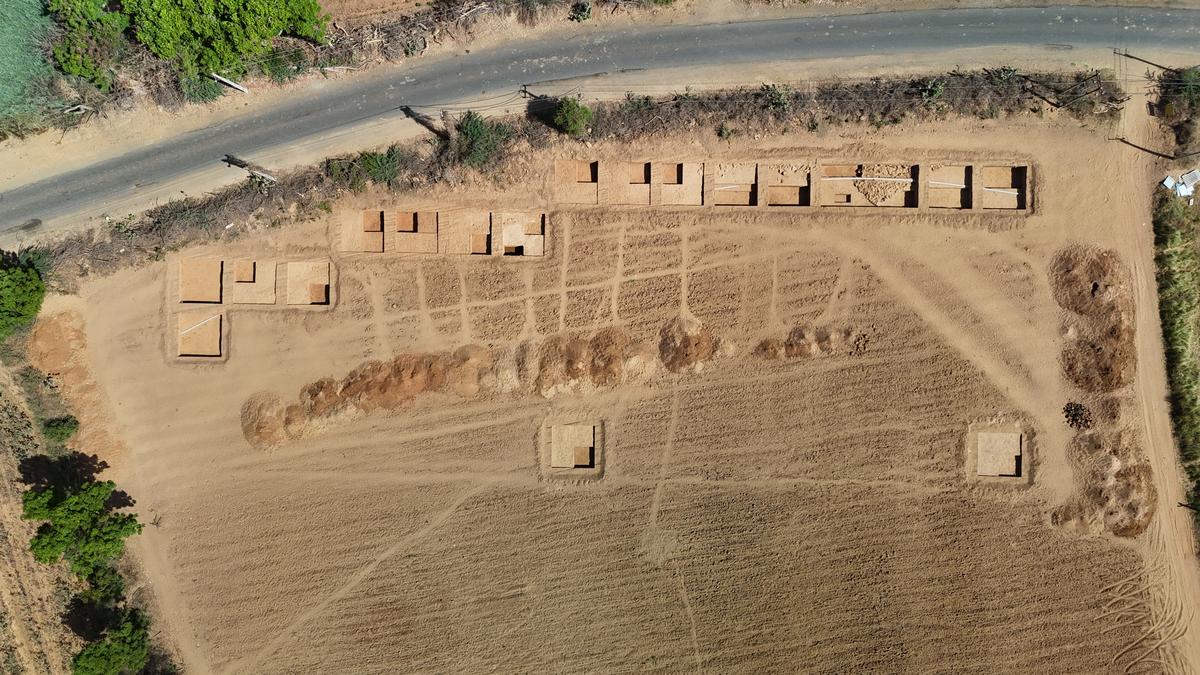
**Lakhapar, Gujarat – June 12, 2025** – A team of archaeologists from the University of Kerala has announced the discovery of a 5,300-year-old Early Harappan settlement near Lakhapar village in Kachchh, Gujarat. The find promises to significantly deepen our understanding of the Early Harappan civilization.
The three-hectare site, identified in 2022, lies near the once-perennial Gandi river and contains structural remnants including sandstone and shale walls, indicating well-planned construction. The excavation has yielded a wealth of pottery, including the extremely rare Pre-Prabhas Ware, previously found at only three other sites in Gujarat.
“The presence of this distinct ceramic tradition at Lakhapar points to a culturally unique group within the larger Harappan civilization,” stated Dr. Abhayan G.S., who led the excavation team along with Dr. Rajesh S.V.
Adding to the intrigue, a human burial containing Pre-Prabhas Ware was discovered, the first such find of its kind. This suggests previously undocumented burial rituals or a unique subgroup within the Early Harappan population.
Alongside pottery, the site has revealed a rich array of artifacts: semiprecious stone beads, shell ornaments, copper and terracotta objects, and Rohri chert blades, indicating connections to the Sindh region. Animal remains, including cattle, sheep, goats, fish bones, and edible shell fragments, suggest a diet based on both animal husbandry and aquatic resources.
“While Gujarat has yielded several Early Harappan burial sites, evidence of associated settlements has been elusive until now,” explained Dr. Rajesh. “Lakhapar bridges that critical gap, offering a rare glimpse into both the living and the dead of the same cultural group.”
The discovery is the result of a collaborative project involving both international and national institutions and builds upon the team’s previous work at the nearby Juna Khatiya necropolis. Archaeobotanical analysis is underway to further understand plant use and ancient diets at the site. The ongoing research promises to offer invaluable insights into the lives and culture of the people who inhabited this region over five millennia ago.
 First Piper