
Fri May 02 04:59:28 UTC 2025: ## CERN Considers Mammoth New Collider to Unravel Universe’s Mysteries
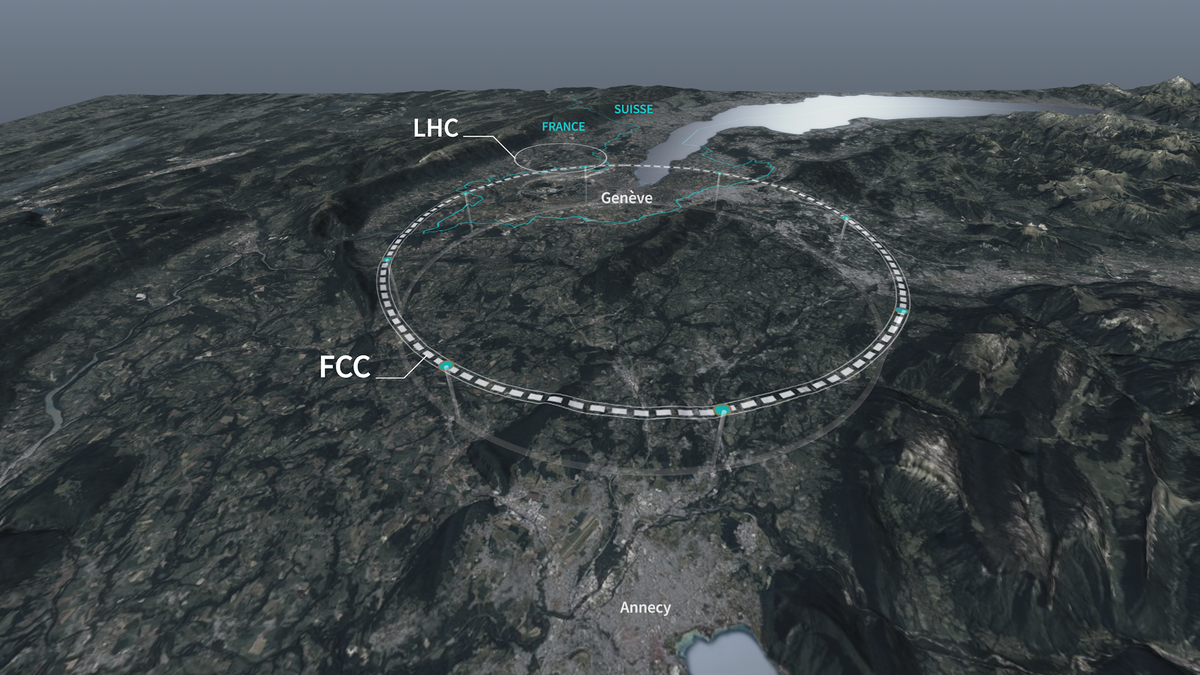
**Geneva, Switzerland –** The European Organization for Nuclear Research (CERN) is considering its most ambitious project yet: the Future Circular Collider (FCC), a 91-kilometer ring that would dwarf even the Large Hadron Collider (LHC). This colossal undertaking, estimated to cost US$18 billion for its first phase, aims to push the boundaries of particle physics and answer some of the universe’s most enduring questions.
The LHC, responsible for groundbreaking discoveries like the Higgs boson, is nearing the end of its operational lifespan. The FCC, over three times its size, would allow scientists to achieve significantly higher collision energies, potentially revealing entirely new particles and forces. The project would unfold in two stages: a first stage focusing on electron-positron collisions for more precise Higgs boson measurements, followed by a proton collider capable of reaching seven times the energy of the LHC.
Scientists hope the FCC will shed light on fundamental mysteries, such as the mechanism behind particle mass, the matter-antimatter imbalance in the universe, and the nature of dark matter. While the project promises breakthroughs, it also faces potential challenges, including competition from a similar Chinese project and the sheer scale of its cost. However, CERN assures that a significant portion of the funding would be covered by its existing budget.
Despite the hefty price tag, the FCC is viewed not just as a scientific endeavor but also as an investment in technological innovation. Spin-off technologies from previous projects, such as medical imaging applications derived from LHC detectors, have already demonstrated the project’s potential for practical benefits. CERN’s history of successful international collaboration adds to the project’s appeal. The final decision on the FCC’s construction remains pending, but the project represents a bold leap forward in humanity’s quest to understand the fundamental building blocks of the universe.
 First Piper