
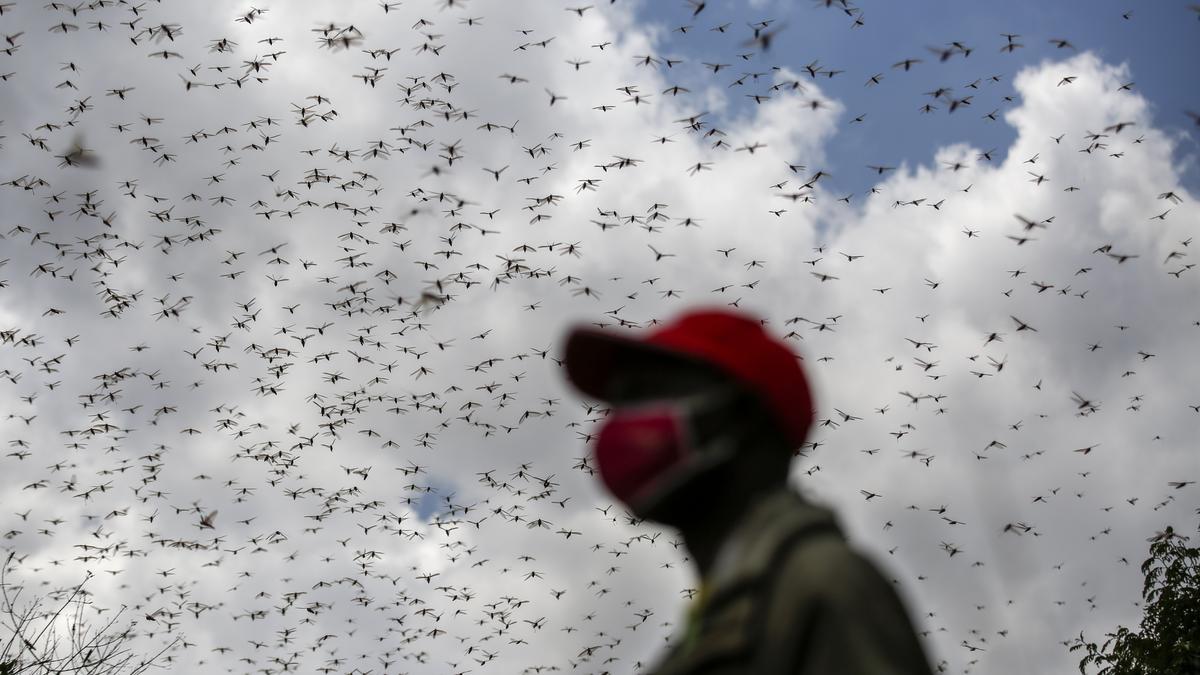
Wed Apr 30 00:00:00 UTC 2025: ## New Locust Swarm Model Challenges Existing Theories, Offering Hope for Future Predictions
**Nairobi, Kenya – April 30, 2025** – A groundbreaking study has revolutionized our understanding of desert locust swarm behavior, potentially offering a crucial tool in combating future outbreaks exacerbated by climate change. Researchers from the Max Planck Institute of Animal Behavior and the University of Konstanz, among others, have debunked a long-held theory that locust swarms behave like gases, instead revealing a complex, vision-driven decision-making process within each insect.
The 2019-2022 locust plague, one of the worst in decades, devastated crops across East Africa and India, destroying over 200,000 hectares of farmland. This prompted scientists to re-examine existing models for predicting swarm movement. Previous models treated locusts as self-propelled particles, aligning with their neighbors like molecules in a gas. However, new research, detailed in a recent paper, revealed a far more sophisticated reality.
Through experiments involving sensory deprivation and immersive virtual reality, researchers discovered that vision, not smell or touch, is the primary driver of locust movement within a swarm. Even in sparse swarms, strong visual cues enabled coordinated movement. This led to the development of a new mathematical model, based on neural networks, that accurately represents locusts as decision-making individuals, albeit without central group planning. The swarm’s coordinated behavior emerges from the collective actions of individual insects.
This discovery has significant implications for predicting and mitigating future locust plagues. Climate change is intensifying the problem by creating favorable breeding conditions. The researchers emphasize the need for further research, including collaboration with climate scientists and vegetation experts, to improve predictive models and develop effective control strategies. The new model, they believe, offers a crucial step toward accurate forecasting and effective management of these devastating swarms.
 First Piper