
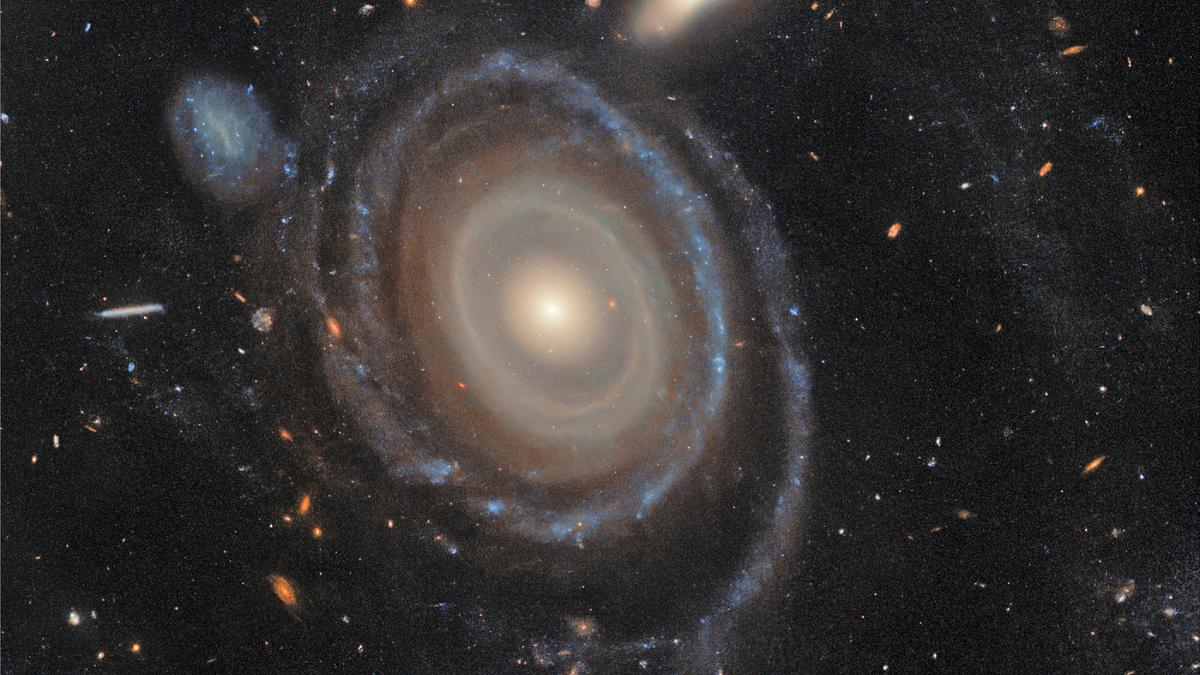
Tue Apr 22 00:00:00 UTC 2025: ## Hubble Captures Stunning “Bullseye Galaxy” – A Key to Understanding Dark Matter?
**Bengaluru, India – April 22, 2025** – An international team of researchers, using data from the Hubble Space Telescope and the W.M. Keck Observatory, have discovered a unique galaxy with nine rings, dubbed the “Bullseye Galaxy” (LEDA 1313424). This serendipitous discovery, detailed in *The Astrophysical Journal Letters*, offers a potential glimpse into the formation of Giant Low Surface Brightness (GLSB) galaxies and the elusive nature of dark matter.
The Bullseye Galaxy’s striking rings are believed to be the result of a smaller blue dwarf galaxy passing through its core approximately 50 million years ago. This interaction caused ripples in the gas within the Bullseye Galaxy, triggering new star formation and creating the distinct ring structure. Remarkably, a faint trail of gas still connects the two galaxies, despite their 130,000-lightyear separation. The Bullseye Galaxy itself is nearly 2.5 times larger than the Milky Way.
The researchers suggest the Bullseye Galaxy may eventually evolve into a GLSB galaxy. These galaxies are characterized by their low surface brightness, abundance of hydrogen gas, and surprisingly low star formation despite their large size. Their unusual properties, including a more uniform mass distribution than predicted by the standard cosmological model, make them intriguing subjects of study, particularly in relation to dark matter.
Dr. Mousumi Das, a professor at the Indian Institute of Astrophysics in Bengaluru, specializing in low surface brightness galaxies, notes that simulations suggest the rapid rotation of dark matter halos surrounding GLSB galaxies might cause their material to spread, creating their unique low-density disks. Studying galaxies like the Bullseye could help verify this theory.
While the transition from a ringed galaxy to a GLSB galaxy is still being explored, the Bullseye Galaxy’s size, hydrogen content, and stellar mass show similarities to GLSB galaxies, making it a compelling candidate for future study. The team hypothesizes that the nine rings will eventually fade, leaving behind a GLSB galaxy. Further research on the Bullseye Galaxy could provide crucial insights into the distribution of dark matter and refine our understanding of galaxy evolution.
 First Piper