
Sun Apr 20 14:17:30 UTC 2025: ## Madurai Railway Division Achieves 110 kmph Train Speeds Through Technological Track Upgrades
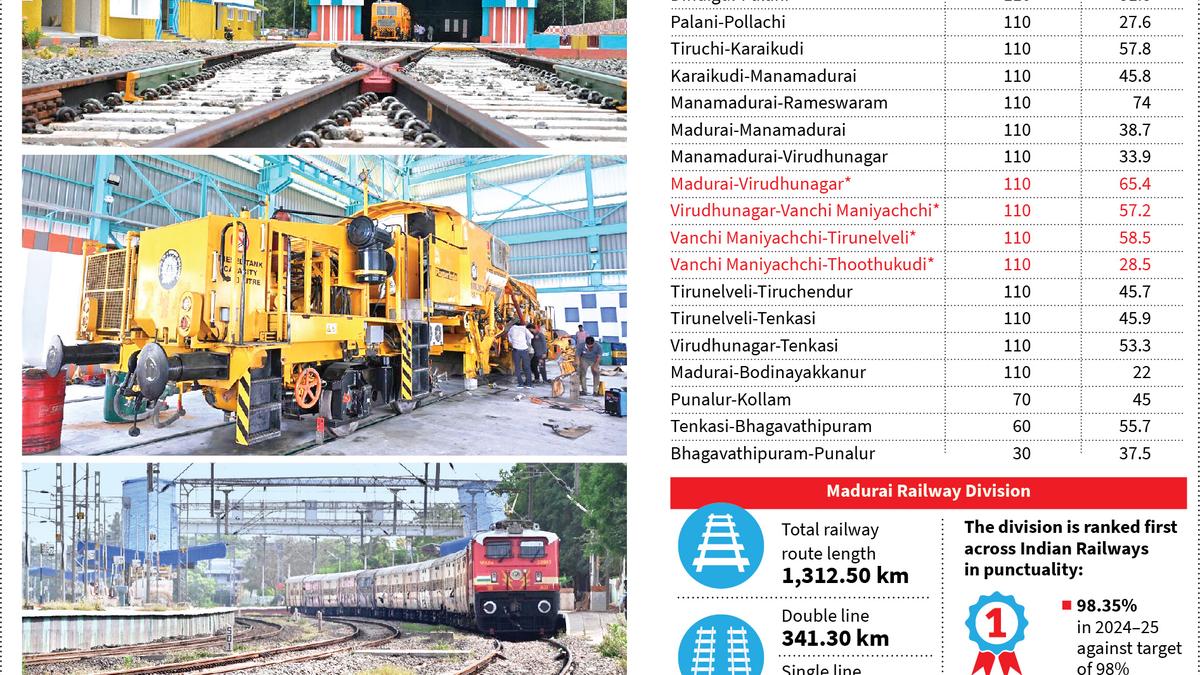
**Madurai, Tamil Nadu, April 20, 2025** – The Madurai Railway Division has successfully increased train speeds to 110 kmph across its network, a significant improvement from the previous 70-90 kmph. This achievement, according to Divisional Railway Manager Sharad Srivastava, is primarily due to meticulous track strengthening and modernization efforts.
While new LHB and Vande Bharat coaches and electrification played a role, the key was a comprehensive overhaul of the tracks themselves. This involved replacing worn-out rails and sleepers, coupled with the implementation of advanced inspection and maintenance technologies.
Traditional manual inspections, including daily track patrols, remain, but are now supplemented by sophisticated systems. The Oscillation Monitoring System pinpoints excessive rail coach oscillation, while the Integrated Track Monitoring System, using AI, identifies precise track defects, ensuring early rectification.
The upgrade wasn’t just about speed; passenger comfort was also a priority. The division actively addresses issues like jerking and clicking sounds, implementing corrective measures using various tamping machines to address alignment, twist, and unevenness in the tracks. Ballast cleaning machines ensure optimal track bed conditions. The elimination of fish-plated rail joints has significantly reduced noise. A shift from 52-kg to 60-kg rails has further enhanced track durability and strength. Out of 1,312 route km, 687 km have already been upgraded to 60-kg rails, with plans to upgrade a further 105 km.
The division has also invested heavily in modern track maintenance machinery, including seventeen machines worth ₹155.60 crore. A new satellite depot in Vilangudi, built at a cost of ₹12.50 crore, now houses and maintains this equipment.
The success story highlights the importance of continuous maintenance and technological advancements in ensuring safe, punctual, and comfortable train journeys for millions of passengers. The shift away from manual maintenance to mechanized systems is a key aspect of this improved service.
 First Piper