
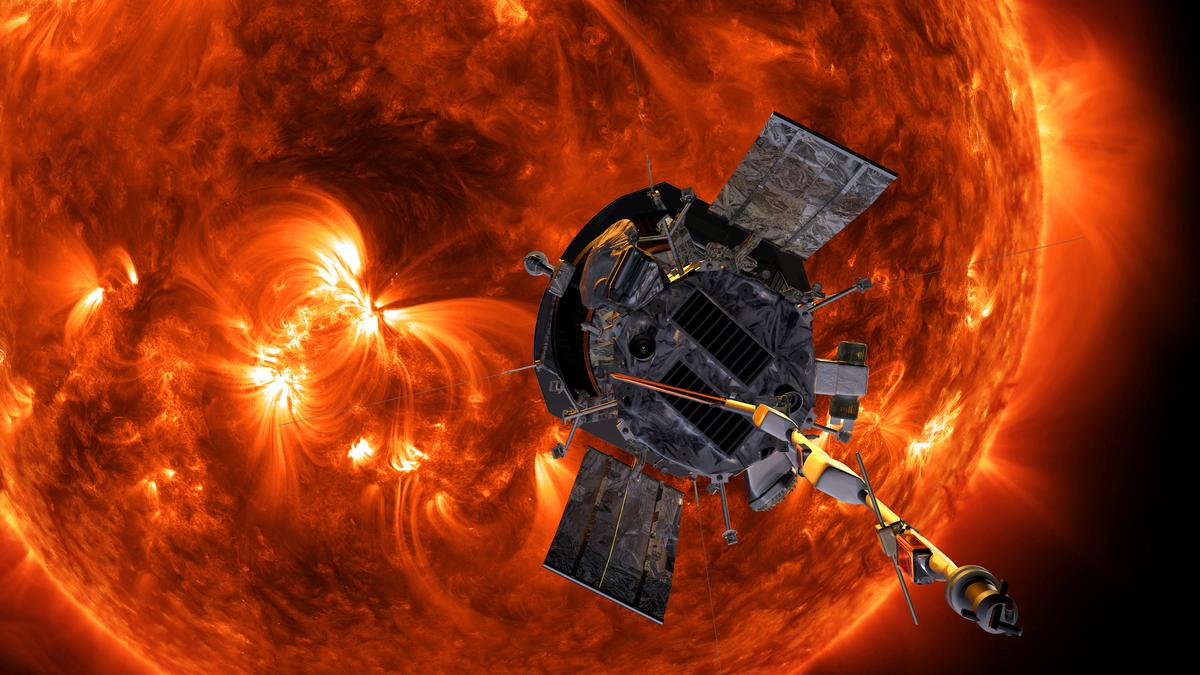
Tue Mar 25 03:30:00 UTC 2025: ## Parker Solar Probe Makes Record-Breaking Close Approach to the Sun
**New Delhi, March 25, 2025** – NASA’s Parker Solar Probe has once again made history, achieving its closest-ever approach to the Sun on March 22nd, coming within 6.1 million kilometers of its surface. This unprecedented proximity, achieved seven years after its launch, allows scientists to gather crucial data about the Sun’s corona and its influence on the solar system.
The probe, named after solar wind predictor Eugene Parker, is equipped with a sophisticated heat shield capable of withstanding temperatures up to 1370°C. Its instruments, including FIELDS, ISoIS, WISPR, and SWEAP, are collecting data on the Sun’s magnetic fields, energetic particles, and the solar wind. A previous “sun-touching” event in April 2021 saw the probe pass beyond the Alfvén surface, a point beyond which the solar wind no longer directly interacts with the Sun’s surface.
Data from the Parker Solar Probe is already yielding significant discoveries. These include the identification of dust-free zones near the Sun and the detection of “magnetic switchbacks,” abrupt reversals in the solar wind’s magnetic field. The probe’s findings are helping scientists investigate the mystery of why the Sun’s corona is far hotter than its surface. The current leading theory attributes this phenomenon to Alfvén waves, oscillations in the solar plasma.
The probe’s journey involved a complex orbital trajectory, utilizing the gravity of Earth and Venus to gradually spiral closer to the Sun. The initial plan to use Jupiter’s gravity was abandoned due to the increased travel time.
The mission is crucial for understanding solar storms, powerful events that can disrupt Earth’s infrastructure and technology. The Aditya-L1 probe, launched by the Indian Space Research Organisation, is also contributing to this research from its position 150 million km from the Sun. The Parker Solar Probe’s next close approach is scheduled for June 19th, further enhancing our understanding of our star.
 First Piper