
Sun Mar 23 19:10:21 UTC 2025: **Tamil Nadu Leader Condemns National Education Policy 2020**
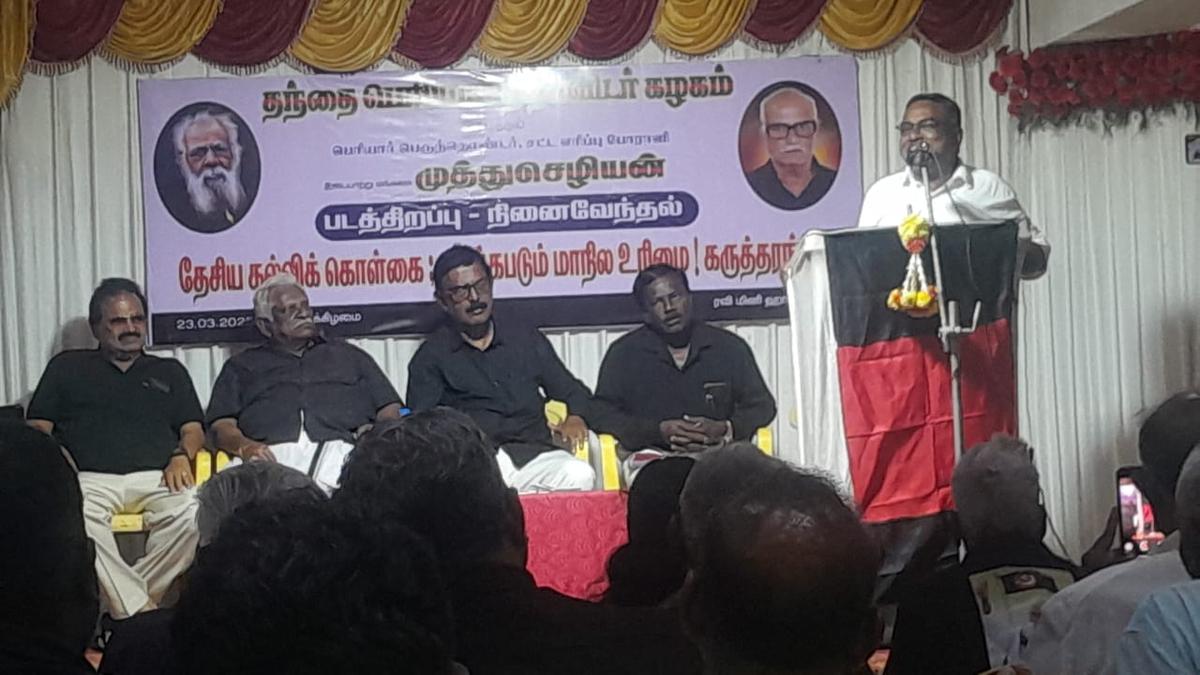
Tiruchirappalli, Tamil Nadu – March 24, 2025 – P.B. Prince Gajendra Babu, general secretary of the State Platform for Common School System-Tamil Nadu (SPCSS-TN), has launched a scathing attack on the National Education Policy (NEP) 2020, calling it unconstitutional and detrimental to educational equality and federal principles. Speaking at a meeting organized by the Thanthai Periyar Dravidar Kazhagam (TPDK), Babu argued that the policy promotes commercialization and inequality at all levels of education, from kindergarten to higher education.
Babu specifically criticized the NEP’s focus on a limited number of elite schools while neglecting existing government schools, violating, he claimed, Articles 14 and 21 of the Constitution. He also voiced concerns about the policy’s vocational training for young children, warning of potential child labor exploitation. Further criticisms included the Common University Entrance Test, Outcome-Based Education, Blended Learning, and the Multiple Entry/Exit system. He also condemned the policy’s allowance of unqualified individuals to become teachers and vice-chancellors, accusing it of undermining state government authority.
Babu demanded the withdrawal of the Higher Education Commission of India (HECI) Bill and urged the Tamil Nadu government to strengthen all government schools equally, eliminating disparities between schools of varying quality. He emphasized the importance of preserving the Samacheer Kalvi system, which he said ensures equal learning opportunities.
Echoing these sentiments, TPDK general secretary K. Ramakrishnan lauded Tamil Nadu’s Chief Minister’s Breakfast Scheme and Noon Meal Scheme for their success in reducing dropout rates, contrasting this with what he described as the central government’s deliberate attempts to increase dropout rates to create a cheap labor pool. Ramakrishnan also condemned the three-language policy as a conspiracy to impose Hindi and suppress regional identities.
 First Piper