
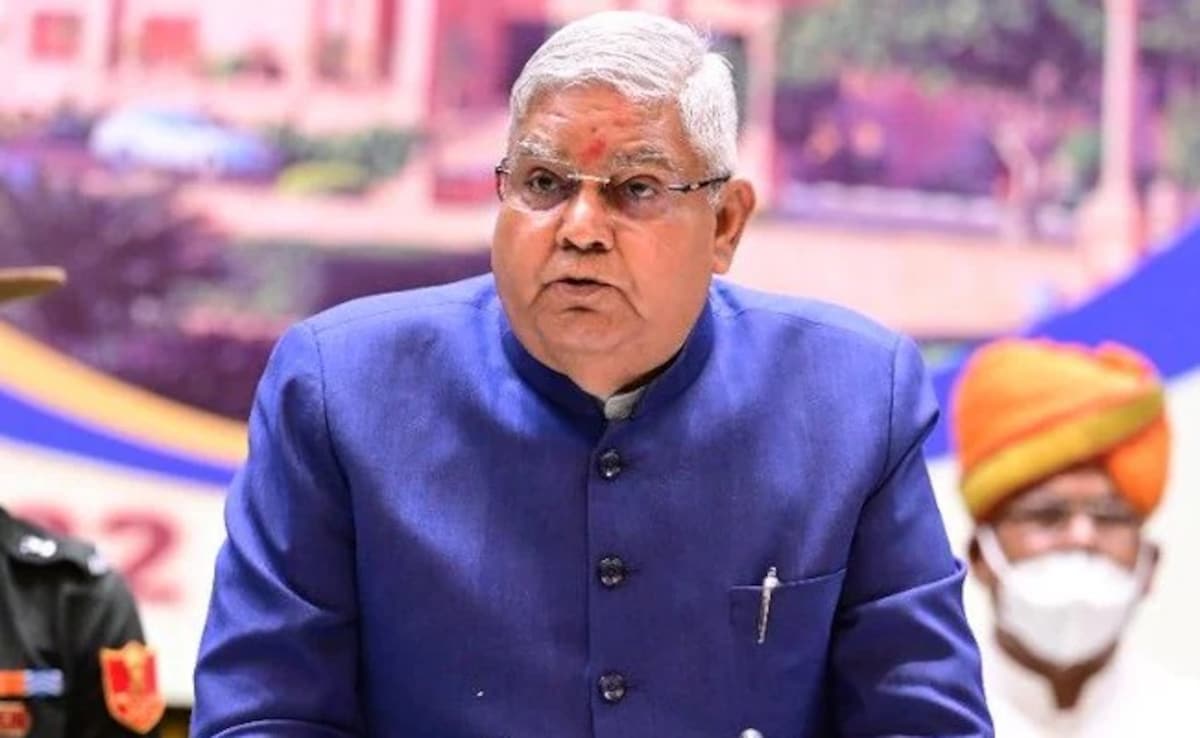
Fri Feb 14 18:47:43 UTC 2025: ## Vice President Dhankhar Criticizes Judicial Involvement in Executive Appointments
**Bhopal, India** – Vice President Jagdeep Dhankhar today strongly criticized the involvement of the Chief Justice of India (CJI) in executive appointments, calling it a breach of the principle of separation of powers. His remarks come ahead of a crucial meeting to select the next Chief Election Commissioner (CEC), following the recent passage of a controversial law that removed the CJI from the selection panel.
Dhankhar questioned the legal basis for the CJI’s participation in appointing the CBI director, arguing that such involvement is incompatible with a democratic system. He acknowledged that the previous statutory prescription stemmed from a Supreme Court verdict but insisted it’s time for a re-evaluation. The new law, passed after a Supreme Court ruling mandated a three-member panel including the CJI, has drawn criticism for allegedly increasing executive interference in the appointment process.
The upcoming CEC selection, scheduled for possibly Monday, will be the first under the new Chief Election Commissioner (Appointment, Conditions of Service And Term of Office) Act, 2023. The selection committee comprises Prime Minister Narendra Modi, Law Minister Arjun Ram Meghwal, and Leader of the Opposition in the Lok Sabha Rahul Gandhi. This meeting takes place a day before the Supreme Court hears petitions challenging the legality of the new law.
Dhankhar, speaking at the National Judicial Academy, expressed concern over “executive governance by judicial decree,” characterizing it as a constitutional paradox. He emphasized the importance of institutions operating within their defined constitutional boundaries and maintaining cooperative dialogue while prioritizing national interests. He further argued that accountability in governance is weakened when executive functions are outsourced or arrogated by non-elected bodies.
Dhankhar also touched upon Article 145(3) of the Indian Constitution, highlighting the need to respect the spirit of the founding fathers’ intentions regarding the Supreme Court’s role in constitutional interpretation. He reiterated Parliament’s supremacy in lawmaking, subject to judicial review, but stressed that the Parliament retains ultimate authority on constitutional amendments. He concluded by emphasizing the importance of dialogue and mutual respect between different branches of government for a healthy democracy.
 First Piper