
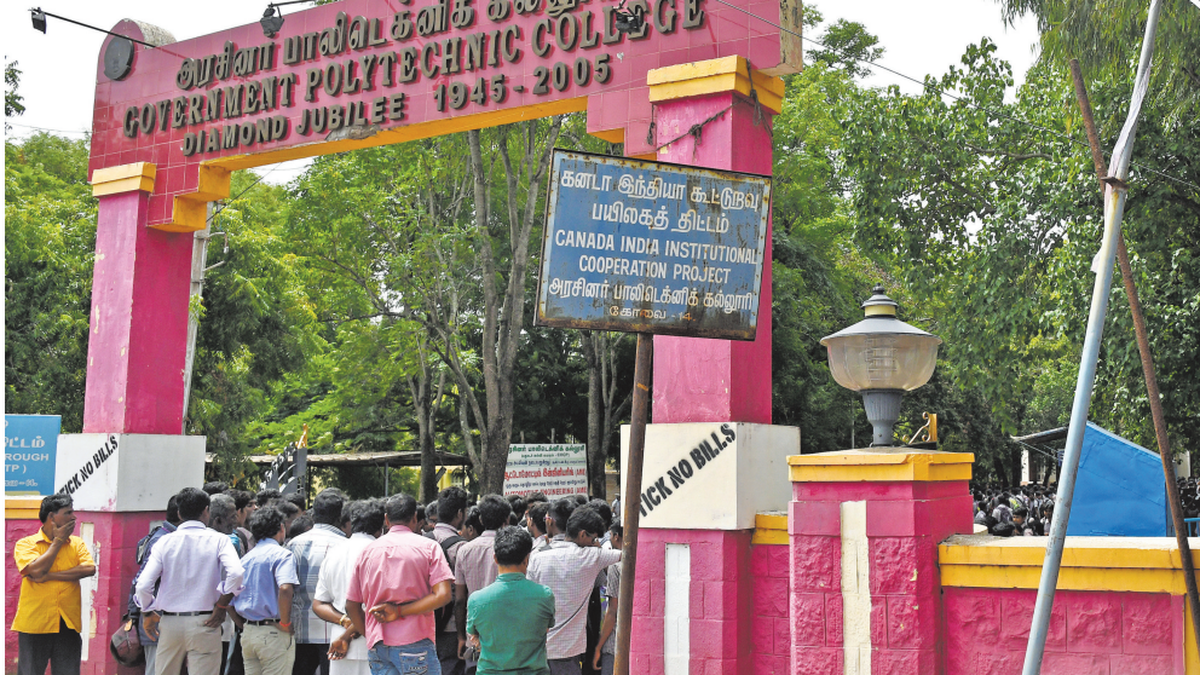
Sat Jan 11 19:06:21 UTC 2025: ## Tamil Nadu’s Technical Education Landscape: A Statewide Analysis Reveals Uneven Distribution and Low Enrollment
**Chennai, January 12, 2025** – A recent All India Council for Technical Education (AICTE) survey reveals a complex picture of Tamil Nadu’s technical education system, highlighting uneven distribution of institutions and significantly low student enrollment, particularly among women. The report, presented at the National Institute of Technical Teachers’ Training and Research (NITTTR) diamond jubilee celebration, reveals that while Tamil Nadu boasts the highest number of engineering and polytechnic colleges in the country, these institutions are not evenly distributed across the state.
The study, covering data up to 2021, shows growth plateaus in both engineering and polytechnic college establishment over the past five years. While all districts have technical institutions, population density does not correlate with the number of colleges. Coimbatore leads with 130 institutions, while districts with populations exceeding 35 lakh have significantly fewer. Conversely, districts with populations under 10 lakh have a disproportionately higher number of colleges.
The survey also reveals that only about half of the sanctioned seats in all technical programs, including diploma, undergraduate, postgraduate, MBA, and MCA, are filled. Vacancies are particularly high in civil and allied subjects. Women’s enrollment remains low at all levels, although those who do enroll are more likely to pursue higher education. For instance, in engineering courses, only 67,164 out of 183,478 sanctioned seats are filled, with just 6,134 women enrolled. The situation is similar for polytechnic colleges, where only 41% of seats were filled in 2023-24 and 2024-25.
The report further indicates a preference for computer science and allied courses, leaving civil engineering programs with high vacancy rates, even in regions with strong SME presence. Experts attribute this to perceived lower demand for civil engineering and the work-from-home option available in IT sectors during and after the pandemic.
NITTTR Director Usha Natesan highlighted the need for courses aligned with emerging technologies and emphasized the importance of addressing public perception of polytechnic education as inferior. NITTTR is actively working to address this through online courses and new postgraduate programs designed for working professionals, while also seeking to relax AICTE restrictions on geographical limitations for participation. The AICTE’s report will be instrumental in informing future policy decisions regarding the state’s technical education strategy.
 First Piper