
Sun Dec 08 15:38:56 UTC 2024: ## Indian Astronomers Make First Detection of Far Ultraviolet Emissions from Novae in Andromeda Galaxy
**Bengaluru, December 8, 2024** – A team of astronomers from the Indian Institute of Astrophysics (IIA) has achieved a significant breakthrough in astronomical observation. Using data from India’s AstroSat satellite, they have, for the first time, detected far ultraviolet (FUV) emissions from novae in the Andromeda galaxy, our nearest galactic neighbor.
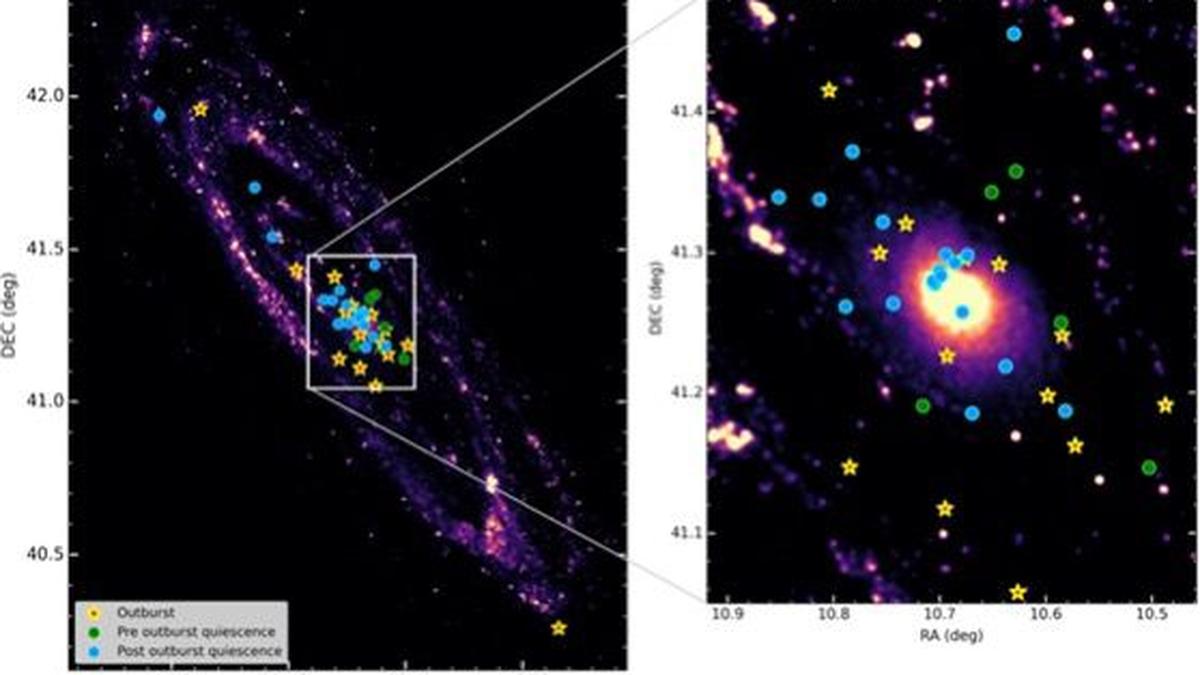
The discovery involved analyzing publicly available data from AstroSat’s Ultraviolet Imaging Telescope (UVIT). The IIA team, led by PhD student Judhajeet Basu, identified FUV emissions from 42 novae, a type of stellar explosion characterized by the sudden brightening of a star. Remarkably, four of these novae were observed during their actual outburst phase.
This unprecedented observation allows scientists to study these interacting binary star systems at various stages of their life cycle, from accumulating matter from their companion star to expelling it into space. The UVIT’s unique capabilities, including its high spatial resolution and simultaneous observation in far and near UV, enabled the team to detect accretion disks in some of these systems, located 2.5 million light-years away. The brightness of these disks correlates directly with the rate at which they consume matter from their companion stars.
The Department of Science and Technology highlighted the importance of this discovery, emphasizing its potential to significantly advance our understanding of novae and binary star systems. The research findings were published [date/publication not specified in source].
 First Piper