
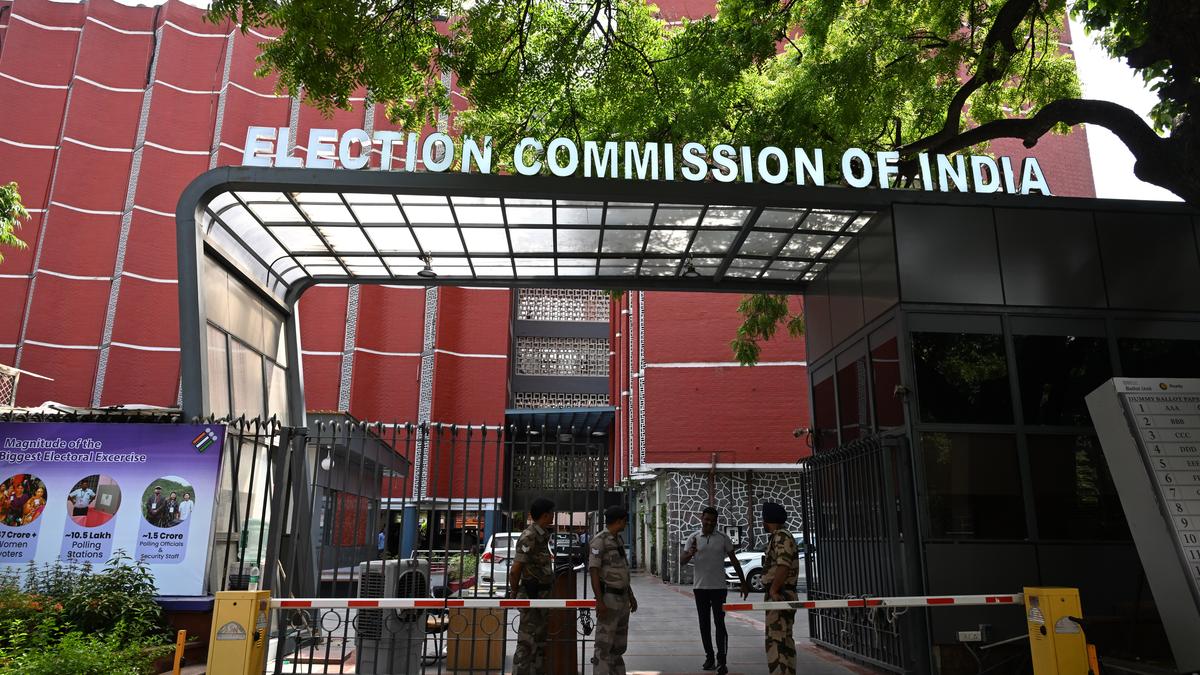
Mon Dec 02 09:13:42 UTC 2024: ## Supreme Court Questions Election Commission’s Increase in Voters Per Polling Station
**NEW DELHI, December 2, 2024** – The Supreme Court of India on Monday questioned the Election Commission of India’s (ECI) decision to increase the maximum number of voters per polling station from 1,200 to 1,500. A petition filed by activist Indu Prakash Singh argues that this increase disenfranchises voters, particularly the underprivileged, due to increased wait times and crowding at polling stations.
The petition, heard by Chief Justice Sanjiv Khanna and Justice Sanjiv Kumar, contends that the ECI’s move, seemingly aimed at reducing election costs, is counterproductive. Instead of increasing the number of Electronic Voting Machines (EVMs) or polling stations, the ECI opted to increase the voter capacity per station. The petition highlights that this approach violates the Representation of People Act, 1951, which mandates a “sufficient number of polling stations for every constituency.”
The petitioners argue that longer queues disproportionately affect daily wage earners and other low-income groups who lose wages while waiting to vote. They emphasized that elections must not only be free and fair but also be perceived as such, requiring equal participation from all electors.
The Chief Justice expressed concern, stating that “no voter should be turned down,” and questioned the ECI’s justification for the increase, particularly in the absence of a new census since 2011. The ECI’s counsel argued that the 1,500 limit has been in place since 2015 and that technological advancements have mitigated potential issues. However, the Chief Justice countered that this doesn’t negate the reality of long queues, especially during peak voting hours.
The court directed the ECI to file an affidavit within three weeks explaining its decision. The case will be heard again the week of January 27, 2025. The petition included calculations demonstrating that even with optimal voting efficiency, a polling station with 1,500 voters would likely lead to excessively long wait times.
 First Piper