
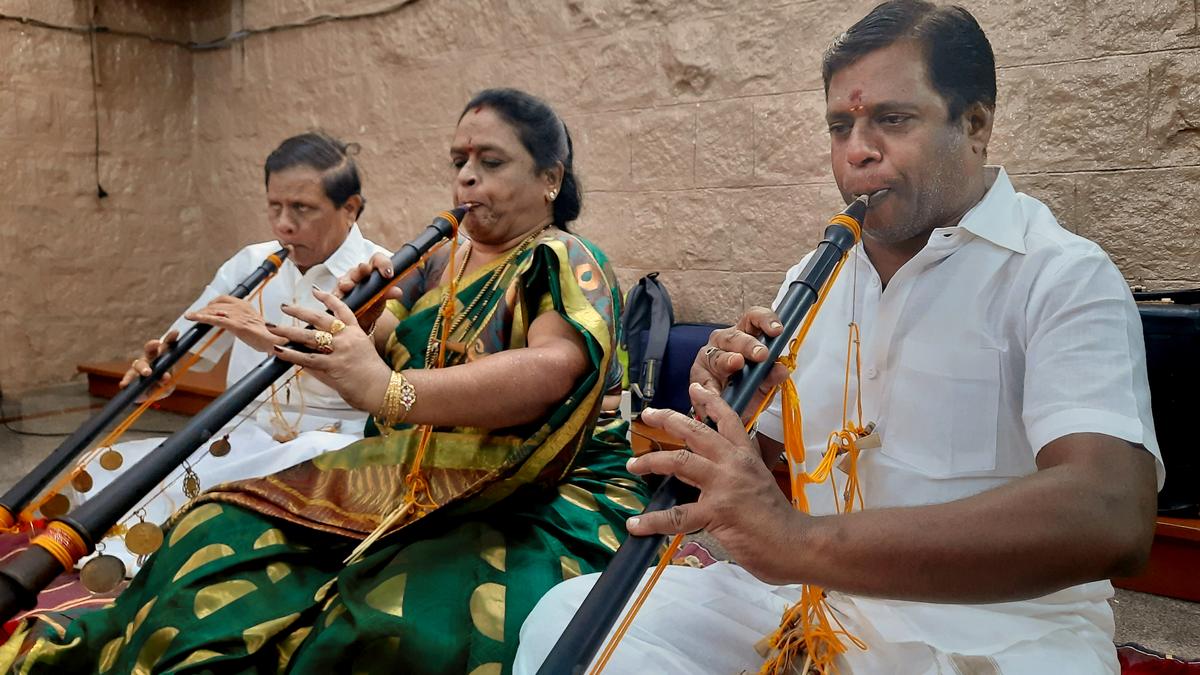
Thu Oct 31 03:30:00 UTC 2024: Published – October 31, 2024 09:00 am IST – BengaluruNadaswaram performance by Kaleeshabi Mahaboob, Sheik Mahaboob Subhani and Firose Babu at Dodda Ganapathi temple. | Photo Credit: RAVICHANDRAN N.
When Kaleeshabi Mahaboob, Padma Shri awardee and the first Indian Muslim woman to perform nadaswaram on stage, says she almost gave up music once to take up tailoring, it feels unbelievable. Because what the world stood to lose had that happened was a divine experience. On stage, flanked by her husband Sheik Mahaboob Subhani (also a Padma Shri recipient) and her son Firose Babu, Kaleeshabi with her nadaswaram is a force to reckon.
Khaleesabi Mahaboob | Photo Credit: SUDHAKARA JAIN
Artistes from a Muslim family practising what is perceived as temple art may seem like an awe-inspiring exception, especially in deeply divisive times. But the couple say they don’t get the fuss about religion.
“What about Bismillah Khan? Parveen Sultana? Zakir Hussain? Yesudas? Isn’t what they create also music?” she asks.
Along with all those legendary names she quotes, Kaleeshabi and Mahaboob are personifications of India’s rich syncretic art tradition and living examples of how boundaries start blurring where music begins.
Nadaswaram and tavil were instruments left behind when vocalist concerts made their way to sabhas and stages. | Photo Credit: RAVICHANDRAN N.
It’s the eve of Dasara. At the Indian Institute of World Culture in Bengaluru, Kaleeshabi in a navy-blue silk saree with orange and golden borders, and Mahaboob in his white silk jubba, looks refreshed and recovered from the pangs of the long journey they took the day before from Tiruchirappalli to Bengaluru, by road.
They get on the stage, adjust their positions, tune the instruments, and then, begin.
‘Raghunayaka ni pada yuga…’ the Thyagaraja keerthana in Hamsadhwani flows from the nadaswarams, accompanied by the beats of Tavil and Talam.
A few heads in the audience start bobbing; Their fingers become metronomes as a taniyavarthanam by the tavil artistes Srirangam V.G. Murugan and Ambur Selva Kumar elevate the show.
Nadaswaram and tavil were instruments left behind when vocalist concerts made their way to sabhas and stages. Performances mostly took place within temples and at weddings.
While nadaswaram artistes predominantly belonged to Isai Vellalar community, there were also a few from Mudaliar and Maruttavar communities too. A few Muslim families in parts of Andhra Pradesh and Tamil Nadu also mastered the instrument, the legendary Sheik Chinna Moulana being a case in point.Mahboob Subhani and Khaleesabi. | Photo Credit: SUDHAKARA JAIN
“Nadaswaram has been in our family for eight generations,” says Mahaboob. “The legend is that our ancestor Hussain Saheb was blessed by ambal herself who said he or his family wouldn’t have rivals for seven generations. We are the eighth. And we didn’t want the legacy to stop with us, so we have trained our son.”
Kaleeshabi was Mahaboob’s paternal cousin. Both were initially trained by their own fathers and uncles. Khaleeshabi being his single child, her father decided to defy existing norms to train her to continue his legacy.
“My father once went to a concert by Madurai Ponnuthai, the first lady nadaswaram artiste. He was inspired and decided to teach me, his only daughter,” Kaleeshabi remembers.
“I was Six years old then, and talented. When I started playing the nadaswaram, the elders were impressed.” She stopped school and started performing at concerts.
“Exciting! I was very happy to travel around for concerts. Going around in cars, buses and trains was exhilarating for the young girl in me,” she says.
Mahaboob, on the other hand, had a different trajectory. Although he learned the instrument, owing to financial difficulties at home, he took up a job at the tobacco factory after finishing SSLC.
When the families fixed their marriage, with it came a suggestion that the duo perform together post-wedding. Mahboob was apprehensive. Having known each other from childhood, he had attended performances by Kaleeshabi.
“I didn’t have the kind of practice or experience she had,” he says. There were also some objections from his family against women performing in public. He told Kaleeshabi his apprehensions.
“Practise, and you can,” she reassured him.
“If you practice and still can’t do it, I’ll stop playing. You continue you work and I shall take up tailoring,” she said.
On December 1, 1977, they tied the knot. Mahaboob continued his job for another year but struggled to find time to practice. Kaleeshabi stepped up again.
“She told me to leave the job. We may struggle for a year or two, but we’ll face it, she said. I left the job,” Mahaboob recollects.
The couple started performing at small concerts, weddings, and temple ceremonies together.In November of 1979, they had a son. Around 20 days later, Mahaboob joined the Sree Sharada Government Music College, Kurnool, to secure a diploma, a probable pathway towards a music job.
A few months later, they got an opportunity to attend the Thiruvaiyaru Thyagaraja Brahmotsavam of 1980. Mahaboob wrote to Kaleeshar, who was still back at home taking care of the baby, wondering if she would be able to perform.
“If you are there, I’ll come. My mom will take care of the baby,” she wrote back.
They reached Thanjavur. The festival in which stalwarts like M.S. Subbulakshmi performed progressed drawing in a massive crowd. Then, the duo was given a midnight slot to perform. But there was a problem. Mahaboob had left behind their nadaswarams in the hotel room.
Help came from none other than Sheik Chinna Moulana who lent them his own instrument.
“He was the disciple of my grandfather Adam Sahib. He gave us his nadaswarams. While Kaleesha played his, I played his grandson Kasim’s nadaswaram.”
After they finished the first keerthanam the crowd broke into applause. There was no turning back then.
As more concerts came their way the couple also started travelling a lot between Tamil Nadu and their native in Andhra. This meant most of the money they were making was being used up for travel expenses. So, in the 1980s they moved to Tiruchirappalli
Sheik Chinna Moulana was only a few kilometres away in Srirangam. They started training under him and continued it for 10 years.
As years passed, awards and recognitions started coming their way along with more programmes. Before receiving Padma shri in 2020, they were honoured with the Kala Ratna award by Andhra government and Kalaimamani award by the Tamil Nadu government.
In 2005, Mahaboob and Kaleeshabi got an invitation from the then President of India APJ Abdul Kalam. The couple was accompanied by their son Firose who was then doing his final year MCA. They remember how Firose, who until then was planning to find a job after finishing his studies, changed his mind at the behest of Kalam.
“APJ reminded him of his legacy. Engineers and doctors are in lakhs, but how many vidwans are there? Don’t leave this; You will be a nadaswara kalaijnar, he blessed him,” Mahaboob remembers.
Lately, Kaleeshabi and Mahaboob have been doing joint concerts with T.M. Krishna, in a unique jugalbandi of sorts between nadaswaram and vocal music. While they believe there is more interest in the art lately, they note that nadaswaram concerts still don’t find as much demand as vocalist concerts do at sabhas.
“The Madras Music Academy regularly calls us. Other sabhas, not so much. It would be nice if they do, it will help build interest in people for nadaswaram,” they say.
“We have had teachers from both religions….Music is our pursuit and penance. It’s not a gift everyone gets,” says Kaleeshabi. | Photo Credit: RAVICHANDRAN N.Kaleeshabi and Mahaboob have by now made their own distinctive mark in the field of nadaswaram. But has their religion ever come in the way?
“Our names might be that of a Muslim. We follow the customs, celebrate Muslim festivals and go for Juma. But we also get invites from Hindu temples all the time. That is because when we are playing nadaswaram, we have no religion.”
“We have had teachers from both religions. Both Chandramouli sir and Sheik Chinna Moulana have fed us in their homes. Music is our pursuit and penance. It’s not a gift everyone gets. So, we have a responsibility towards it. When we don’t know where we go after death, why fight over caste and religion?”
Kaleeshabi adds to it by recollecting an incident.
“I had no practice of wearing a pottu. Once when we were playing at mariamman koil, a maami walked up to me with some kumkumam. I felt it was the amman herself offering it to me. So, I accepted it with humility and started wearing one then on. We respect customs of all religions. And we don’t see religion in music.”
She stops and breaks into a Keerthana. “Akhilandeshwari raakshamaam…” Pitch perfect.
Published – October 31, 2024 09:00 am IST
music / culture (general) / arts, culture and entertainment / history and culture
Copyright© 2024, THG PUBLISHING PVT LTD. or its affiliated companies. All rights reserved.
Terms & conditions | Institutional Subscriber
Comments have to be in English, and in full sentences. They cannot be abusive or personal. Please abide by our community guidelines for posting your comments.
We have migrated to a new commenting platform. If you are already a registered user of The Hindu and logged in, you may continue to engage with our articles. If you do not have an account please register and login to post comments. Users can access their older comments by logging into their accounts on Vuukle.
 First Piper