
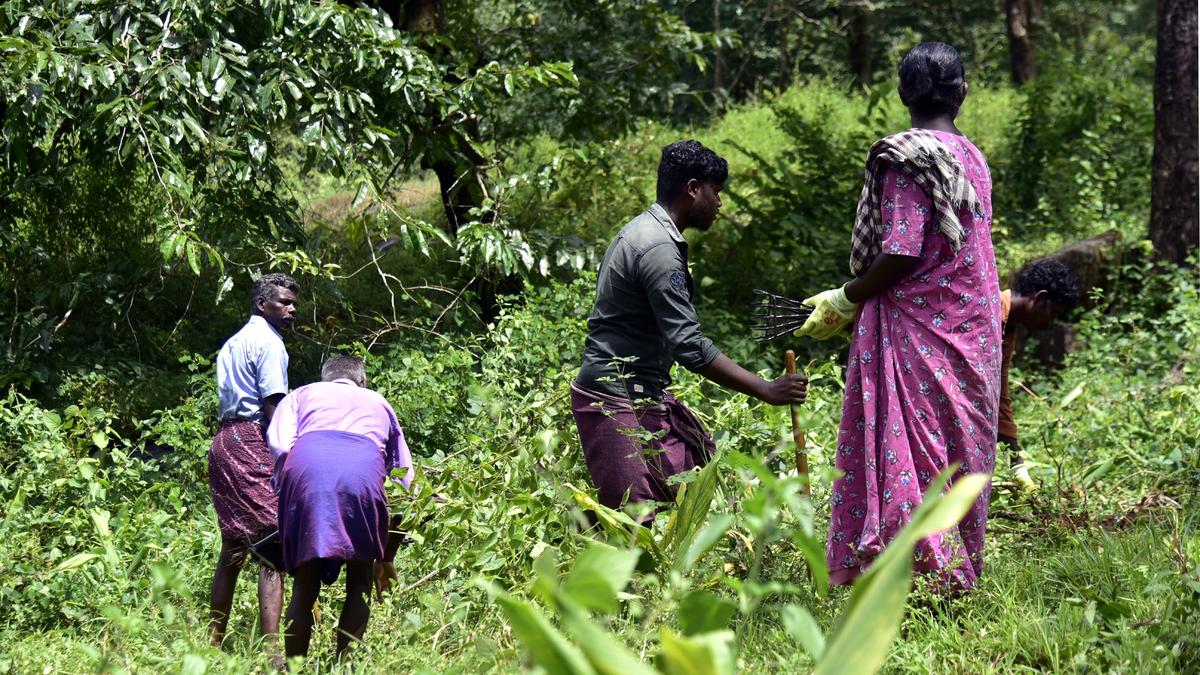
Fri Oct 25 15:43:54 UTC 2024: Published – October 25, 2024 09:13 pm IST – ThrissurMembers of the Kadar tribe taking up restoration of natural forests degraded by invasive alien species at Pothupara, under Vazhachal forest division in Thrissur. | Photo Credit: SPL
In a first, the Kadar tribe of Vazhachal, Kerala, has taken on active restoration of natural forests degraded by invasive alien species.
This collaborative effort involving the Local Self-Governments department, MGNREGA,Scheduled Tribes Development department, WWF-India, and Kerala Forest Research Institute (KFRI), marks a significant step towards freeing natural forests from degrading exotic species.Supported by the WWF-India, the KFRI had undertaken the mapping of invasive plants in the Vazhachal and Parambikulam forest divisions. A total of 29 and 31 invasive species had been recorded in these divisions, according to T.V Sajeev, chief scientist, KFRI.
“By involving tribal community members in a participatory mapping process, we identified the most degraded areas for restoration,” he says. The spread of invasive plants has severely limited forage space for wildlife, including elephants, spotted deer, and gaur, leading to increased human-wildlife conflicts. Additionally, these invaders have diminished the availability of non-timber forest products, threatening the livelihoods of the indigenous communities.
With technical support from the KFRI, the tribal community has started the removal of invasive species such as Lantana camara, Chromolaena odorata, Mimosa diplotricha, and Mikania micrantha.
The work will be followed up by planting of species such as Myristica beddomei, Canarium strictum, Garcinia gummi-gutta, Hydnocarpus pentandrus, Curcuma neilgherrensis, Acacia sinuate, Phyllanthus emblica, Entada rheedii, Desmodium gangeticum, Pseudarthria viscida and Sapindus trifoliate, all of which yield forest products usually collected by the community. Over the years, these plants had been displaced by the aggressive invasion of alien plants.
“This initiative not only supports the environment but also enhances the livelihoods of local tribal communities by increasing labour opportunities through the MGNREGA,” says K. Rijesh, ward member of Athirappilly grama panchayat.The pilot project is being held at Pothupara, a newly established tribal hamlet formed under Vazhachal division after a landslip displaced the people from Anakkayam in 2018. This community received Community Forest Resource (CFR) rights under the Forest Rights Act (FRA) in 2014, along with eight other tribal settlements, creating the first CFR area of its kind in Kerala, covering 400 sq. km. The nine tribal gram sabhas have already approved their conservation and management plan, which incorporates this vital restoration work.
“This initiative showcases how the CFR right holders under the FRA are protecting and regenerating their resources by leveraging traditional knowledge, all while being overseen by the gram sabhas,” says Tiju C. Thomas, associate coordinator at the WWF-India.
As the programme progresses, it aims to revive the natural habitat that sustains both local flora and fauna, ultimately enhancing the livelihoods and sustainability of tribal communities. “This initiative is crucial for restoring the ecological balance and supporting those who depend on these forests,” says R. Lekshmi, divisional forest officer, Vazhachal forest division.
Aligned with the UN General Assembly’s declaration of 2021–2030 as the UN Decade on Ecosystem Restoration, this project contributes to a global mission to halt and reverse ecosystem degradation. “This collaboration among various agencies, focused on a unified goal, exemplifies the incredible ingenuity of the indigenous community in taking action on the ground,” says Dr. Sajeev.
Published – October 25, 2024 09:13 pm ISTCopyright© 2024, THG PUBLISHING PVT LTD. or its affiliated companies. All rights reserved.
Terms & conditions | Institutional SubscriberComments have to be in English, and in full sentences. They cannot be abusive or personal. Please abide by our community guidelines for posting your comments.
We have migrated to a new commenting platform. If you are already a registered user of The Hindu and logged in, you may continue to engage with our articles. If you do not have an account please register and login to post comments. Users can access their older comments by logging into their accounts on Vuukle.
 First Piper