
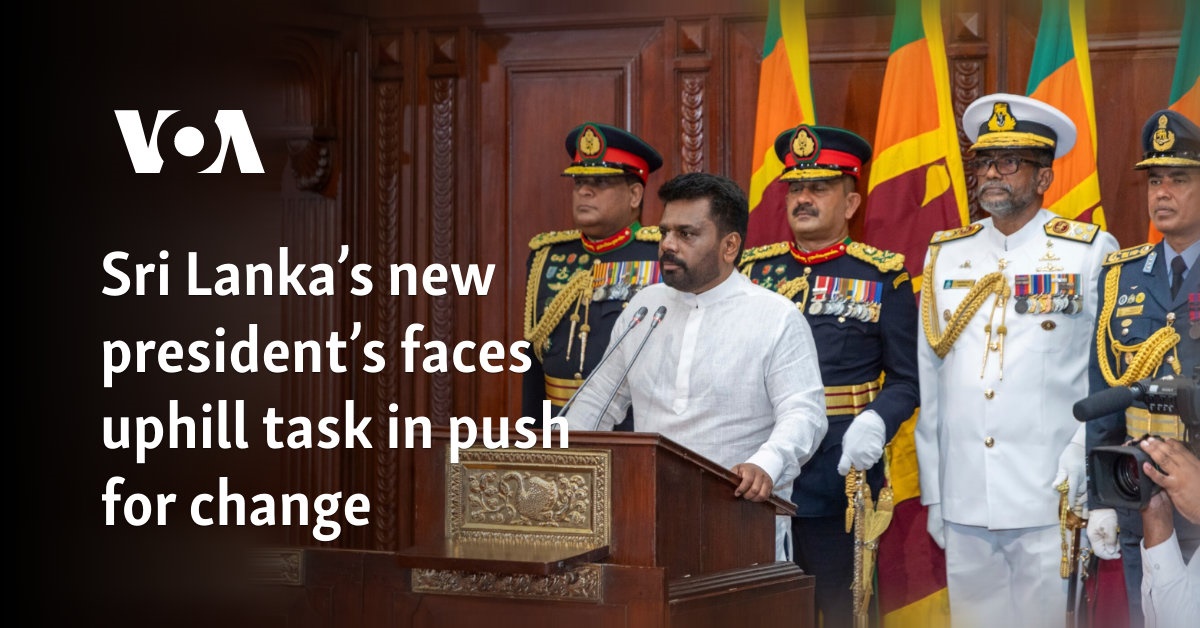
Wed Sep 25 06:50:20 UTC 2024: ## Sri Lanka’s New Marxist-Leaning President Faces Tough Task Amidst High Hopes
Sri Lanka’s newly elected president, Anura Kumara Dissanayake, a Marxist-leaning leader who rose to power on an anti-corruption platform, faces a formidable challenge in fulfilling his promises to clean up the country’s political culture and alleviate poverty. Despite winning the presidential election on an anti-establishment wave, Dissanayake’s party holds only three seats in the 225-member parliament, making him highly reliant on securing a comfortable majority in upcoming elections scheduled for November 14th.
Dissanayake’s commitment to clean governance and his pledge to renegotiate the country’s bailout deal with the International Monetary Fund (IMF) are crucial factors driving public expectations. However, analysts caution that his success hinges on navigating complex political landscapes and balancing economic priorities.
The IMF, which has provided a $2.9 billion bailout package to stabilize the country’s economy, expressed optimism about working with Dissanayake. While the IMF’s strict criteria for fiscal discipline remain in place, the president is expected to ease the burden on lower-income groups by reducing taxes on food, medicine, and income.
Dissanayake’s Marxist background and commitment to protectionist policies have raised concerns within the business community. While he has moderated his party’s hard-left stance in recent years, skepticism about his approach to free market policies persists.
The president’s promises to combat corruption, a deep-rooted issue in Sri Lanka, face significant challenges. “Corruption is very deep-seated in the system,” said Jehan Perera, head of the National Peace Council. “He will face strong vested interests to rebuild a system that has broken down.”
Dissanayake’s victory has ignited hope amongst millions of Sri Lankans weary of the political elite. However, managing public expectations and delivering on his ambitious agenda will require deft leadership and the ability to navigate complex political dynamics. “The management of the economic crisis and management of public expectations will be his biggest challenge,” said analyst Jayadeva Uyangoda. “This is the first time there is a president who belongs to the working class, so the hopes of the ordinary people are very, very high.”
 First Piper