
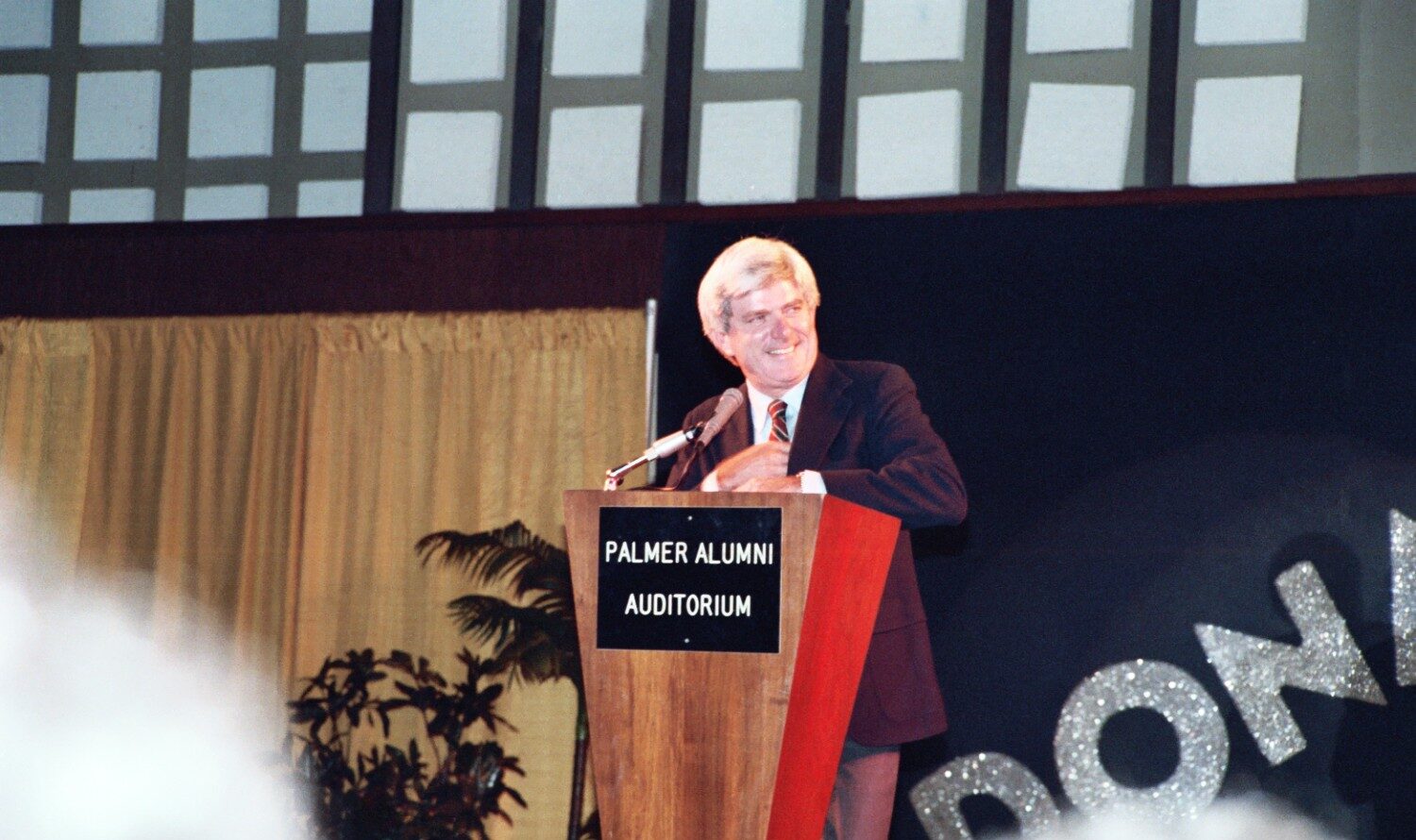
Wed Sep 25 04:01:00 UTC 2024: ## Phil Donahue, Pioneer of Cold War Diplomacy, Passes Away at 88
**London -** The death of renowned American talk show host Phil Donahue at the age of 88 marks the end of an era, not only for television but also for a unique form of diplomacy that helped bridge the divide between the United States and the Soviet Union during the Cold War. While Donahue is best known for his pioneering daytime talk show format, his lesser-known role as an unofficial diplomat, fostering dialogue between citizens of both superpowers through real-time televised conversations known as “space bridges,” holds renewed significance today as tensions between the US and Russia escalate.
Donahue’s “The Phil Donahue Show,” which debuted in 1967, was groundbreaking for its format, allowing viewers to participate in discussions on pressing social issues. This innovative approach not only reshaped daytime television but also influenced future media icons like Oprah Winfrey and Ellen DeGeneres. However, it was Donahue’s “space bridge” initiatives, in collaboration with Soviet-American journalist Vladimir Pozner, that truly stand out.
The first “space bridge” in December 1985 connected 175 Russians in Leningrad with 175 Americans in Seattle via satellite for a two-and-a-half-hour discussion. Despite initial political focus, participants gradually shifted towards personal experiences and shared concerns. The program reached millions of viewers on both sides of the Iron Curtain, proving that even amidst heightened Cold War tensions, human connection was possible.
Donahue and Pozner continued these “space bridges” throughout the mid-1980s, each focused on different topics, and always seeking to humanize the “enemy” through shared conversation. Notably, the “Women Talk to Women” teleconference in 1986, and the “We Wish You Happiness” program in 1986, which honored American schoolgirl Samantha Smith, a symbol of hope for peace, further cemented their efforts.
While Donahue’s “space bridges” were groundbreaking, the shift in the media landscape and the end of the Cold War created new challenges. His career was impacted by his outspoken opposition to the Gulf War and the Iraq War. However, his commitment to principle and journalistic integrity remained unwavering, as evidenced by his 2007 documentary “Body of War,” which explored the impact of war on American soldiers.
Donahue’s passing comes at a time when the world faces new and dangerous confrontations, particularly with the ongoing war in Ukraine. The current environment, marked by media blockades and increasing hostility, makes a repeat of his “space bridges” seem like a lost relic of a more hopeful time.
However, Donahue’s legacy serves as a call to action, reminding us that even in the most adversarial situations, dialogue can be a powerful tool for building understanding and fostering common ground.
The need for new “space bridges” in today’s polarized media landscape is more pressing than ever. As we navigate a world increasingly driven by fear and misinformation, Donahue’s pioneering spirit, coupled with his commitment to open dialogue, serves as a crucial reminder of the potential for media to bridge divides and build a more peaceful future.
 First Piper