
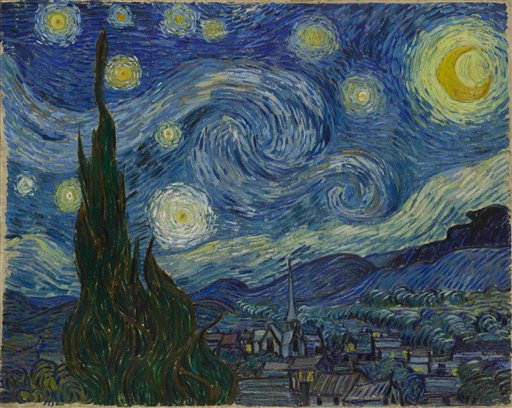
Mon Sep 23 15:15:00 UTC 2024: ## Van Gogh’s “Starry Night” Captures a Scientific Truth: Turbulence in the Sky
**Xiamen, China** – A team of physicists from Xiamen University in China has discovered that Vincent Van Gogh’s iconic painting “The Starry Night” accurately reflects a fundamental law of fluid dynamics, a concept known as turbulence. This scientific principle, first articulated by Russian mathematician Andrey Kolmogorov in the 1940s, describes how energy moves through air and water.
The researchers, led by Yongxiang Huang, studied the swirling patterns in Van Gogh’s night sky and found them to align with the predicted patterns of turbulent flow. “Imagine you are standing on a bridge, and you watch the river flow,” Huang explains. “You will see swirls on the surface, and these swirls are not random. They arrange themselves in specific patterns, and these kinds of patterns can be predicted by physical laws.”
Despite being painted decades before Kolmogorov’s discovery, “The Starry Night” captures these complex patterns with remarkable accuracy. The team believes Van Gogh’s profound understanding of natural phenomena might have stemmed from his observations of clouds and the atmosphere, or perhaps from an innate ability to capture the dynamism of the sky.
This finding highlights the remarkable connection between art and science, revealing how even seemingly abstract artistic expressions can embody deep scientific truths. “Van Gogh’s painting reveals a deep and intuitive understanding of natural phenomena,” Huang concludes.
 First Piper